The Bracelets of King Djer: four workmen found a mummified arm hidden in a tomb wall, still wearing its jewels
Famous find Made about 3000 BC, in the 1st Dynasty · Found in 1901 See it on the timeline →
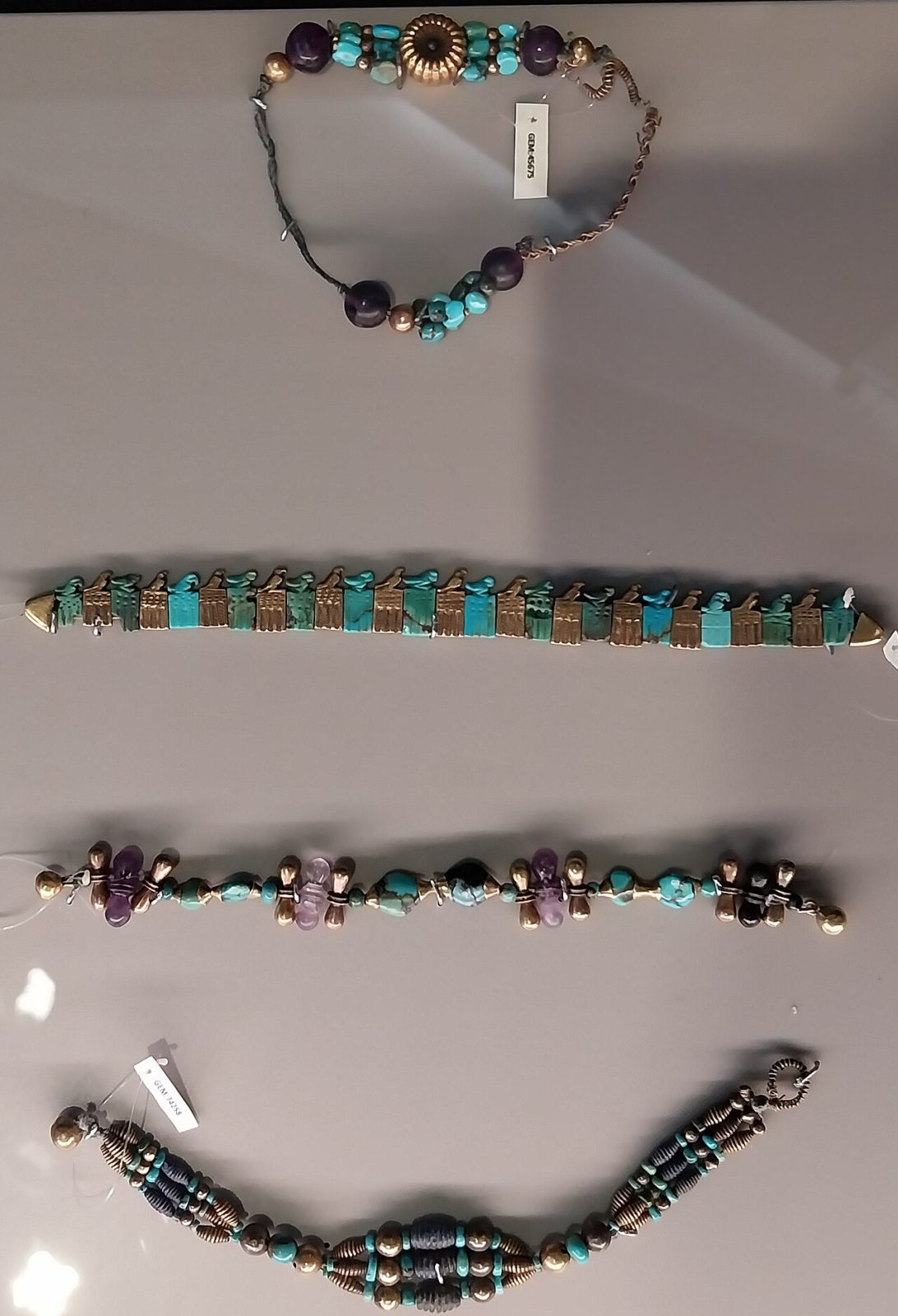
In the winter of 1900–01, workmen digging for Flinders Petrie in the tomb of King Djer at Abydos found part of a mummified arm in a hole in the wall. Inside its wrappings were four bracelets of gold, turquoise, lapis and amethyst, among the oldest royal jewellery in the world.
In the winter of 1900 to 1901, Flinders Petrie was excavating the royal tombs of Egypt's first kings at Umm el-Qa'ab, near Abydos. In the tomb of King Djer, who ruled around 3000 BC, a party of four Egyptian workmen noticed part of a mummified arm, still in its linen wrappings, lying in a broken hole in the north wall. Peeping into the end of the wrappings, they saw a large gold bead. They did not search any further or take anything. They left the arm where it was until Petrie's assistant, Arthur Mace, came to look, and he had it carried back to the dig house.
That evening Petrie cut open the linen, with the most senior of the four men watching. On the arm were four bracelets, still in their original order. Petrie, his wife Hilda and Mace spent an hour or two recording exactly how each was strung. The gold was weighed in front of the workman, and the men were paid rather more than its value.
One bracelet is made of 27 little plaques, 13 of gold and 14 of turquoise, each shaped like a palace front topped by the Horus falcon, the sign of a king. Another has a gold rosette with turquoise and amethyst beads, its sides plaited from fine gold wire and hair. A third has lapis lazuli beads carved to imitate coiled gold wire, and the fourth has hourglass beads of gold and amethyst. Petrie found the gold so soft that he could open a coil with his fingernail.
Petrie believed the arm had belonged to Djer's queen, and that an ancient robber had broken up her body, hidden the arm in the wall to come back for and never returned. Nobody noticed it for thousands of years. The arm itself did not survive its rediscovery: according to Petrie, when the bracelets reached the museum in Cairo, the arm and its linen were thrown away. Petrie's photograph is all that remains of what may be one of the oldest mummified royal remains ever found.
The bracelets are now displayed in the Grand Egyptian Museum at Giza.
Written for Global Finds from W. M. F. Petrie, The Royal Tombs of the Earliest Dynasties, part II (1901), his memoir Seventy Years in Archaeology (1931), and the Egypt Exploration Society. Photo: the four bracelets of King Djer in the Grand Egyptian Museum, Hyspaosines, Wikimedia Commons, CC BY 4.0.
Linked finds
Source: Egypt Exploration Society