The Elsing Pendant: a gold coin copied from a Frankish emperor, pierced and worn, perhaps lost by a soldier of the Viking Great Army
Famous find Made about AD 825 to 860, probably in Frisia · Found in 2024 See it on the timeline →
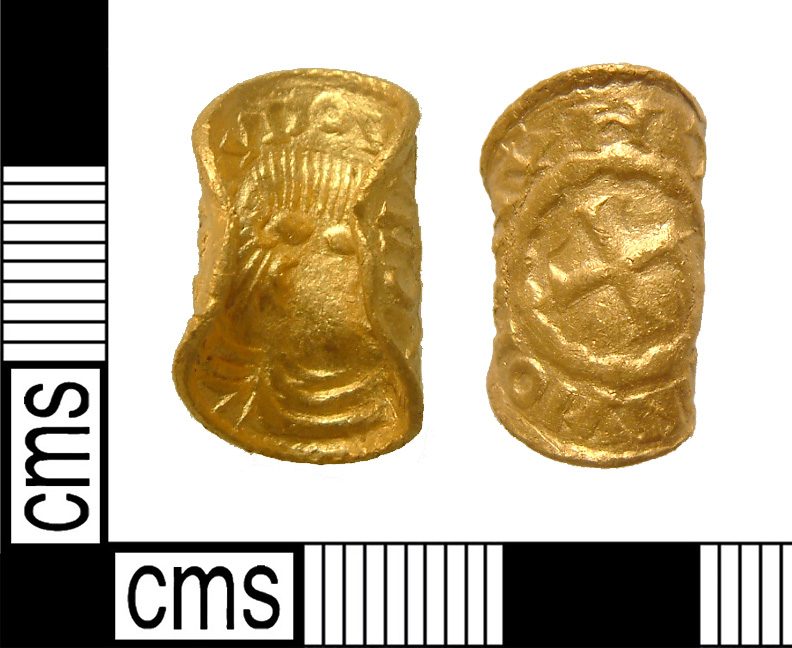
In September 2024 a metal detectorist at Elsing in Norfolk found a gold coin copied from a solidus of the Frankish emperor Louis the Pious, pierced to hang as a pendant. Experts think it may have been lost by a member of the Viking Great Army that invaded England in 865.
In September 2024, a metal detectorist searching a field at Elsing, near Dereham in Norfolk, found a small gold coin with two holes punched above the emperor's head. The finder's name has not been published. It was reported through the Portable Antiquities Scheme and announced in February 2026.
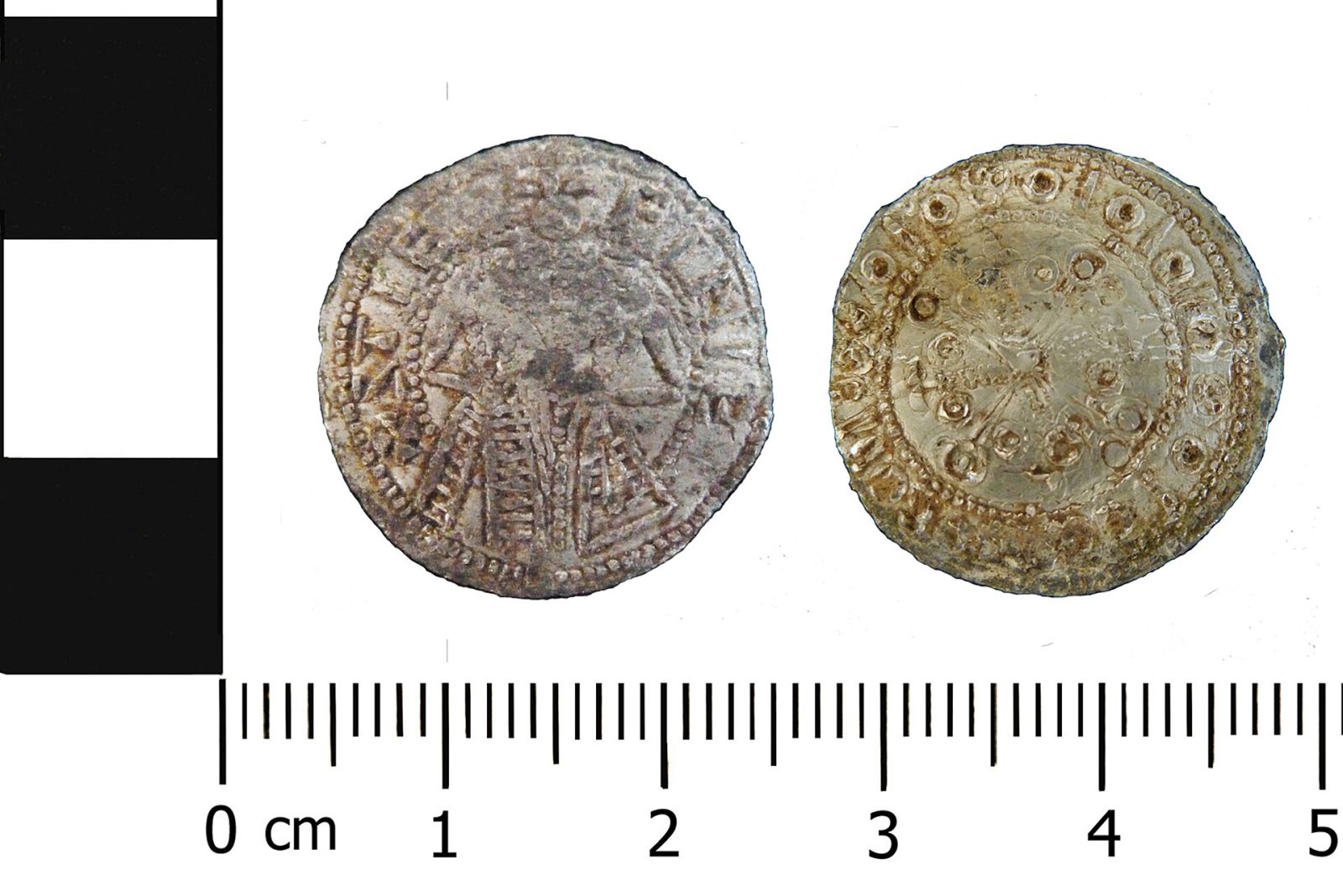
The coin is about 20 millimetres across. It copies a gold solidus of Louis the Pious, the son of Charlemagne, who ruled the Frankish empire from 814 to 840. The originals, struck around 816 as gifts for the emperor's great nobles, are extremely rare; only a handful are known. This one is not an original but a gold imitation, probably made in Frisia, in what is now the Netherlands, in the 840s or 850s. Its legends are garbled copies of the Latin, including a version of MVNVS DIVINVM, "divine gift". It belongs to the better-made early group of these copies. The two holes show that it was worn as a pendant, with the emperor's face to the front.
The numismatist Simon Coupland has studied these imitations. More than a hundred are known across Europe, and 22 have now been found in Britain, this one being the second from Norfolk. Their findspots in England seem to follow the route of the Great Heathen Army, the Viking force that landed in East Anglia in 865 and fought across England for more than a decade. Coupland thinks the Elsing coin was probably lost by one of its soldiers, wearing a piece of foreign gold as a pendant or a mark of status.
Because it is gold and more than 300 years old, the coin is going through the Treasure process, and Norwich Castle Museum hopes to acquire it.
Written for Global Finds from BBC News (2026), Live Science (2026) and The History Blog (2026). Photo: another gold imitation of a solidus of Louis the Pious, found in Wiltshire, not the Elsing coin, Katie Hinds, Salisbury and South Wiltshire Museum, Portable Antiquities Scheme, Wikimedia Commons, CC BY-SA 2.0.
Source: BBC News (2026)