The York Arm-Ring: a third of a kilo of Viking gold, found in a builder's sock drawer after his death
Famous find Made in the Viking Age, 9th to 10th century AD See it on the timeline →
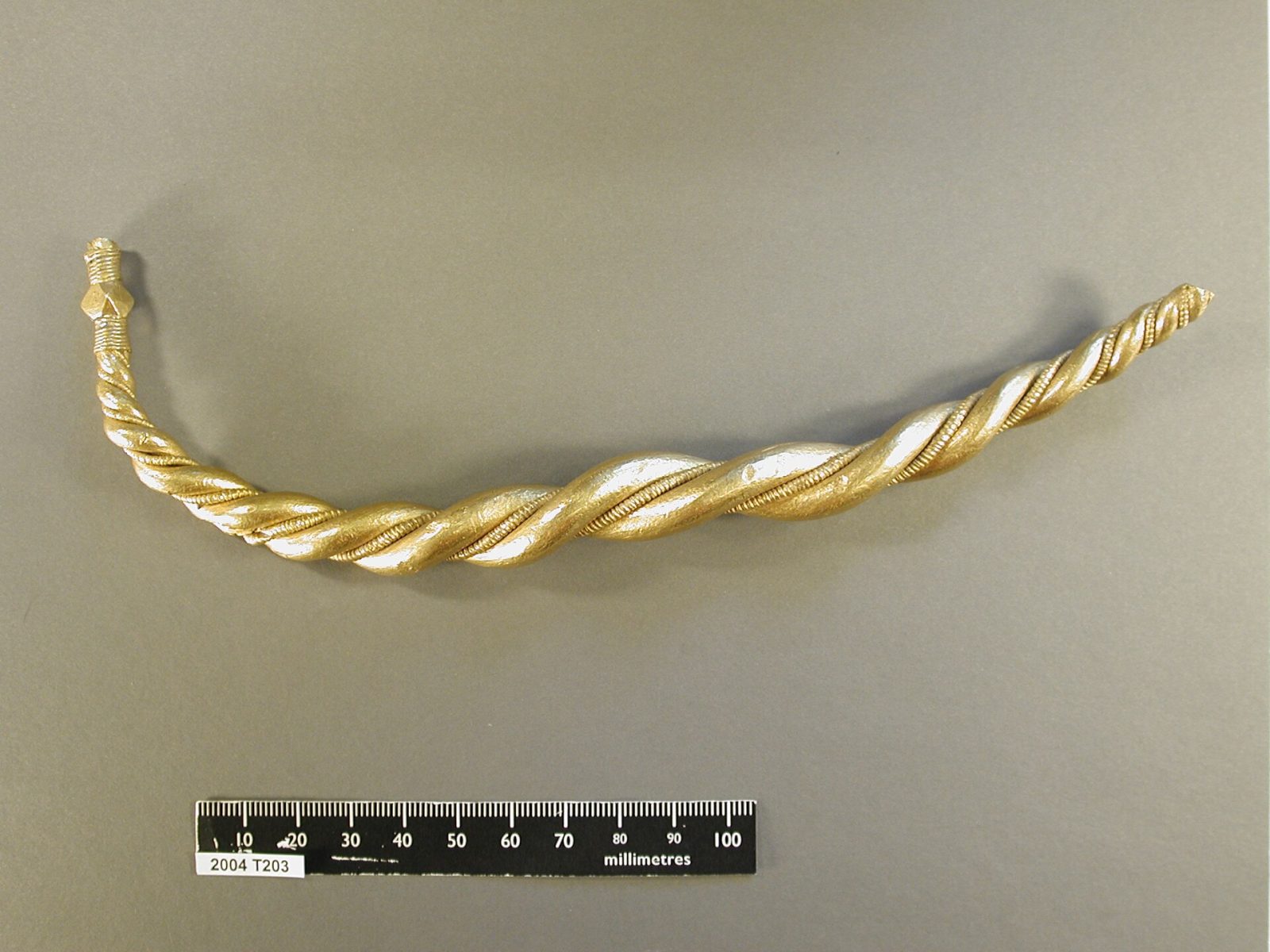
After a York builder died, his son and daughter found a massive Viking gold arm-ring among his belongings, thought to have come from a building site in the York area. Weighing 324.6 grams, it was declared Treasure in 2004 and is now in the Yorkshire Museum.
When a builder from York died, his son and daughter, going through his belongings, came across something extraordinary: a heavy twisted ring of gold. According to the museum account of the find, it was in their father's sock drawer. He seems to have found it during building work in or around York and never reported it. His children took it to the Yorkshire Museum. Their names, and their father's, have not been published, and exactly when and where it was found is unknown.
The ring was dealt with as a Treasure case in 2004. The British Museum's report described it as about 95 per cent gold, weighing 324.6 grams, about a third of a kilogram, and 260 millimetres long. It is made of two thick gold rods with a beaded gold wire between them, twisted together into a rope that tapers towards the ends, where they meet in a plain many-sided knob bound with fine wire. At some point it was cut through and partly straightened, so it no longer forms a closed ring. A small crescent-shaped nick on one rod looks like a test cut, made by someone checking that the gold was real.
Rings like this were worn on the arm by the Viking elite, and they were also portable wealth: a lord could reward his followers with gold, and a ring could be cut up and weighed out as payment. Close parallels have been found at Wipholm in Germany, in Dublin, at Hornelund in Denmark and at Goodrington in Devon. The York ring was made between the 9th and 11th centuries, and most probably dates from the time when York, then called Jorvik, was the capital of a Viking kingdom, until about 954. The museum suggested it was worn by a Viking royal or a favoured warrior.
The Yorkshire Museum acquired the ring, and it was shown at the British Museum in 2010 in an exhibition of treasures from medieval York before returning for the Yorkshire Museum's reopening that summer. It is displayed there today.
Written for Global Finds from the British Museum's Treasure report on the ring (2004 T203, via the Portable Antiquities Scheme), Museum Crush, the History of York (York Museums Trust) and the British Museum (2010). Photo: the York Viking gold arm-ring, Harriet Louth, British Museum, Portable Antiquities Scheme, Wikimedia Commons, CC BY-SA 4.0.
Linked finds
Source: Museum Crush