The Polizy Sultani: an Ottoman sultan's gold coin, lost in a Bohemian meadow and found three centimetres down
Famous find Struck at Constantinople, 1520 to 1566 · Found in 2022 See it on the timeline →
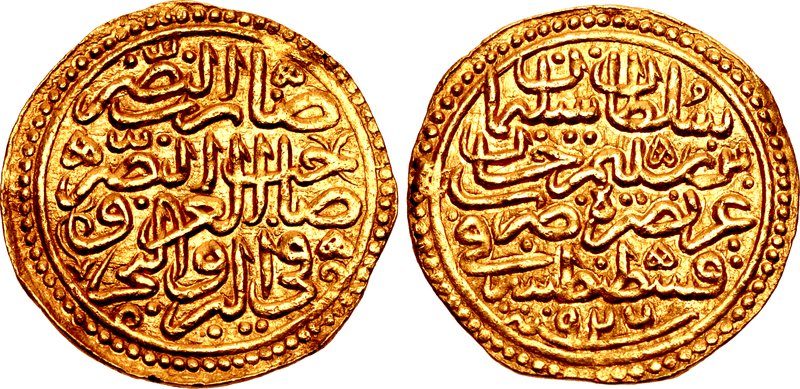
On 26 June 2022 detectorist Miloš Hrdý found a gold coin of the Ottoman sultan Suleiman the Magnificent just three centimetres below a meadow at Polizy, in eastern Bohemia, Czech Republic. He gave it to the Museum of East Bohemia in Hradec Králové.
On 26 June 2022, the metal detectorist Miloš Hrdý was searching a meadow on the western edge of Polizy, near Hradec Králové in eastern Bohemia, in the Czech Republic. Just three centimetres below the surface, he found a small, bent gold coin covered in Arabic script. The area around the findspot was searched carefully afterwards, but no other coins turned up, so it seems to have been a single coin lost by its owner.
It was a sultani, the gold coin of the Ottoman Empire, struck at Constantinople, now Istanbul, for Sultan Suleiman I, known in Europe as Suleiman the Magnificent. It weighs 3.44 grams and is 20.9 millimetres across. It carries the date 926 in the Islamic calendar, AD 1520, the year Suleiman came to the throne, but that date appears on all his gold coins, so it could have been struck at any time in his long reign, which lasted until 1566.
Suleiman's reign was the high point of Ottoman power in Europe. His armies took Belgrade in 1521, crushed the Hungarian army at Mohács in 1526 and besieged Vienna in 1529, and for the next century and a half much of Hungary was ruled from Constantinople. Ottoman gold coins, valued for their purity, circulated well beyond the empire's borders. In Bohemia they turn up in hoards from the late 16th century, especially during and after the Thirty Years' War of 1618 to 1648, when soldiers from across Europe moved through the region. The only earlier single find of a coin of Suleiman in this area was made in a field near Chvalkovice, probably before 1900.
In September 2022, Hrdý gave the coin to the Museum of East Bohemia in Hradec Králové, and it was published by the numismatist Vojtěch Brádle in Numismatické listy, the coin journal of the National Museum in Prague.
Written for Global Finds from V. Brádle, "A find of a gold Ottoman coin at Polizy", Numismatické listy 77 (2022). Photo: a gold sultani of Suleiman I of the same type, struck at Constantinople, not the Polizy coin, Classical Numismatic Group, Wikimedia Commons, CC BY-SA 2.5.
Linked finds
Source: Numismatické listy (2022)