The Brewham Denarius: a £1 coin, then the silver of Britain's first breakaway emperor, at a Somerset dig
Famous find Struck in the reign of Carausius, AD 286 to 293 · Found in 2024 See it on the timeline →
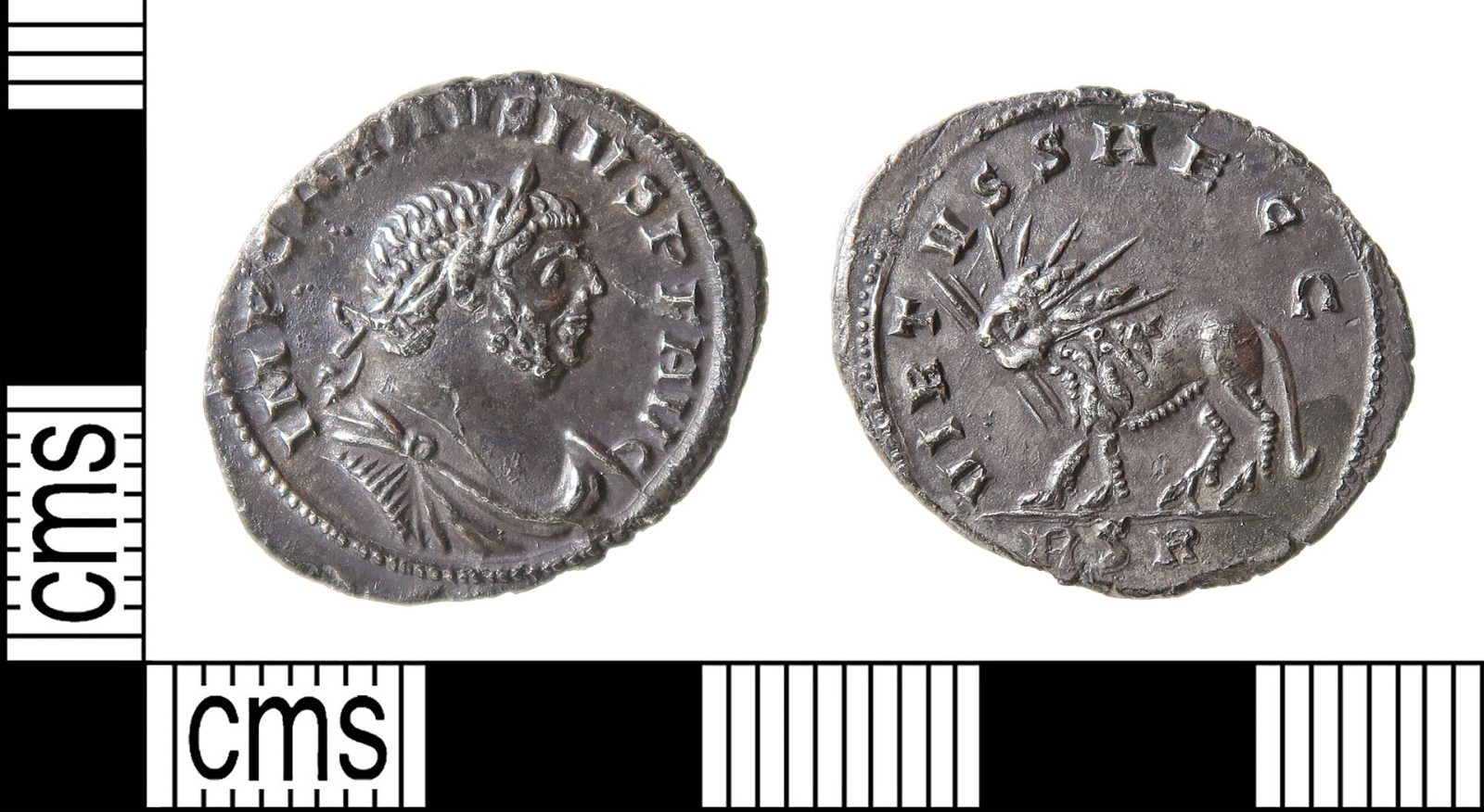
On 9 June 2024 Mike Clark, a retired fisherman with 52 years of detecting behind him, dug a £1 coin on pasture at South Brewham in Somerset. His next signal was a rare silver denarius of Carausius, the admiral who made himself Emperor of Britain.
On 9 June 2024, Mike Clark, a 73-year-old former commercial fisherman from Wimborne in Dorset, joined an organised dig with about 20 other detectorists on pasture fields at South Brewham, near Bruton in Somerset. Clark had been detecting for 52 years, and he was using the XP Deus he had owned for many years. The morning produced nothing. In the afternoon, on another field, his first signal was a modern £1 coin. The next, about six inches down, was a small silver coin. "I recognised it immediately as a denarius of the Roman Emperor Carausius," he said, and he contacted the local Finds Liaison Officer so that it could be recorded.
On one side is the laureate bust of Carausius. On the other is a lion wearing a radiate crown and holding a thunderbolt, with the letters RSR. Nigel Mills of the auctioneers Noonans explained that they stand for Redeunt Saturnia Regna, "the reign of Saturn returns", a line adapted from Virgil's Eclogues that promised a new golden age. Noonans said this coin had never been published.
Carausius commanded the Roman fleet in the English Channel, the Classis Britannica. In AD 286 the emperor Maximian ordered his execution, suspecting him of keeping treasure captured from pirates. Carausius responded by declaring himself emperor of Britain and northern Gaul, which is why Noonans called him the first "Brexiteer". His coins were unusually well made for the time, and his silver denarii, rare in the Roman world by then, were part of his claim to be a legitimate emperor. In 293 he was murdered by his own finance minister, Allectus, who took his place until Rome reconquered Britain in 296.
As a single coin, the denarius was not Treasure. It was offered by Noonans Mayfair on 22 October 2024 with an estimate of £6,000 to £8,000, and Clark said he would share the proceeds with the landowner. The result has not been widely reported.
Written for Global Finds from Greatest Hits Radio (2024), quoting the finder and Noonans, and Noonans (2024). Photo: another silver denarius of Carausius with the lion, thunderbolt and RSR, found in Hampshire, not the Brewham coin, Katie Hinds, Hampshire Cultural Trust, Portable Antiquities Scheme, Wikimedia Commons, CC BY 2.0.
Linked finds
Source: Greatest Hits Radio (2024)