The Port Famine Coin: a metal detector found the silver laid at the founding of a colony that starved to death
Famous find Struck at Potosí, laid in 1584 · Found in 2026 See it on the timeline →
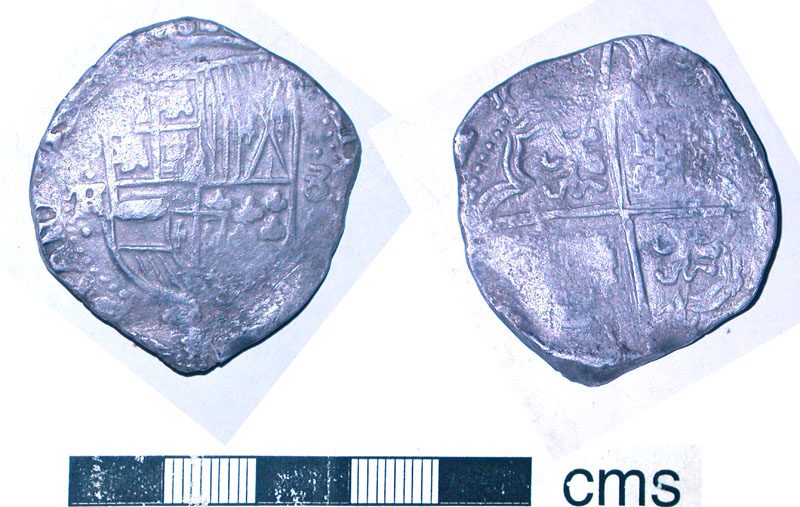
Archaeologists using metal detectors on the Strait of Magellan in Chile, in work announced in 2026, found a silver piece of eight of Philip II on a foundation stone of a ruined church. It matched an account of the founding of Rey Don Felipe in 1584, the colony later called Port Famine.
In March 2026, a Chilean team led by the historian Soledad González Díaz of Bernardo O'Higgins University announced a discovery on the north shore of the Strait of Magellan, about 56 kilometres south of Punta Arenas. For several years the project had been searching for the remains of Ciudad del Rey Don Felipe, a Spanish colony founded in 1584, guided by the writings and map of its founder, Pedro Sarmiento de Gamboa. Using metal detectors and precise satellite positioning, the team picked up a signal inside the outline of a small church. "We detected a strong signal, but we didn't know what it was until we carried out targeted excavations," said the archaeologist Francisco Garrido of Chile's National Museum of Natural History.
It was a silver real de a ocho, a piece of eight, of King Philip II of Spain: a hand-cut coin of the kind called a cob, struck at Potosí in what is now Bolivia, with the royal arms on one side and a cross with lions and castles on the other. It lay on a stone surface inside the church, which González Díaz said was exactly the place described in the historical sources. Accounts of the colony's foundation describe a coin being placed at the first stone of the church, a ceremony performed in 1584. Reports differ on whether the coin lay on or under the stone.
The colony was one of the worst disasters of Spanish America. Sarmiento's fleet had left Spain in 1581 to fortify the strait against English ships after Francis Drake had sailed through it. Several hundred settlers were landed in 1584, but cold, hunger and disease killed almost all of them. In 1587 the English navigator Thomas Cavendish found the ruins and a handful of survivors, and named the place Port Famine, Puerto del Hambre, the name it still bears.
Because the coin sits exactly where the sources put it, the team is using it as a fixed point to map the rest of the colony, including its houses, stores and defences. Under Chilean law, archaeological finds belong to the State.
Written for Global Finds from HeritageDaily (2026), El Mostrador (2026), Archaeology magazine (2026) and The Past (2026). Photo: another silver eight reales of Philip II, found in England, not the Port Famine coin, Frances McIntosh, National Museums Liverpool, Portable Antiquities Scheme, Wikimedia Commons, CC BY-SA 2.0.
Source: HeritageDaily (2026)