The Augst Coin: a bronze struck in Italy before Rome had the denarius, lost almost unworn in a Swiss Roman town
Famous find Struck in Italy, middle of the 3rd century BC · Found in 2024 See it on the timeline →
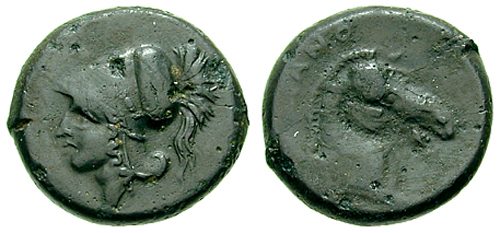
In 2024 archaeologists on a rescue dig at Augusta Raurica, the Roman town at Augst near Basel, found a small bronze coin with the head of Minerva and a horse's head. Struck in Italy in the 3rd century BC, it is the oldest coin ever found there.
Since April 2023, archaeologists from Augusta Raurica, the Roman town at Augst near Basel in Switzerland, had been carrying out a rescue excavation ahead of a new building project. Their finds already included a terracotta figure of Venus and a small bronze cockerel. In 2024 the team found a small bronze coin, and on 28 November 2024 they announced that it was the oldest coin ever found at the site, and the first find of its kind in Switzerland.
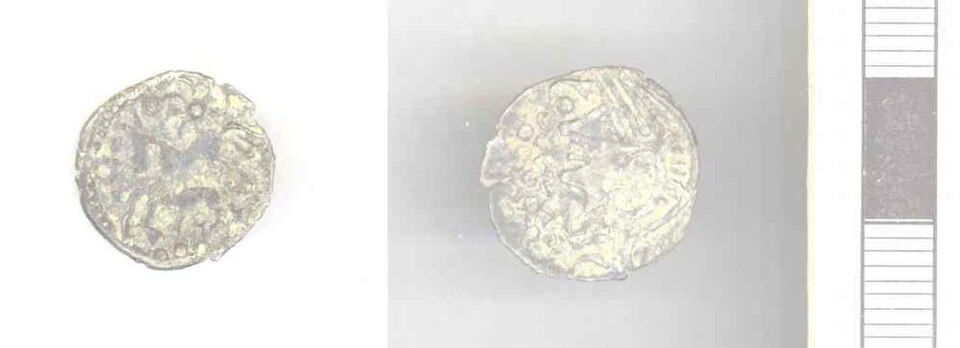
On one side of the coin is the head of the goddess Minerva wearing a helmet; on the other, the head of a horse. It was struck in Italy in the middle of the 3rd century BC, probably for Rome, in the generation of the wars with Carthage, and before Rome had even introduced the silver denarius in 211 BC. Coins of this kind are common finds in Italy, but rare north of the Alps.
What puzzled the archaeologists was its condition. The coin was already around 300 years old when it was lost or buried at Augusta Raurica, a town founded as a Roman colony in the 40s BC that grew under the emperors, yet it shows astonishingly little wear. The archaeologists suggest that it was treasured and kept with care, perhaps as a lucky charm or as a keepsake from a distant homeland in Italy, before it finally disappeared into the ground.
The same excavation produced other remarkable finds, including stone fragments carved with the names of two townsmen, Marcus and Gaius. These appear to have marked reserved seats in the front rows of the town's amphitheatre for wealthy citizens. Under Swiss law, archaeological finds belong to the canton, in this case Basel-Landschaft, which runs the excavations and museum at Augusta Raurica.
Written for Global Finds from Augusta Raurica (2024) and Swissinfo (2024). Photo: another bronze coin of the same type, with the helmeted head of Minerva and a horse's head, not the Augst coin, Classical Numismatic Group, Wikimedia Commons, CC BY-SA 3.0.
Linked finds
Source: Augusta Raurica (2024)