The Diquís Spheres: banana workers bulldozing a Costa Rican jungle uncovered hundreds of perfect stone balls
Famous find Most made between about AD 800 and 1500 See it on the timeline →
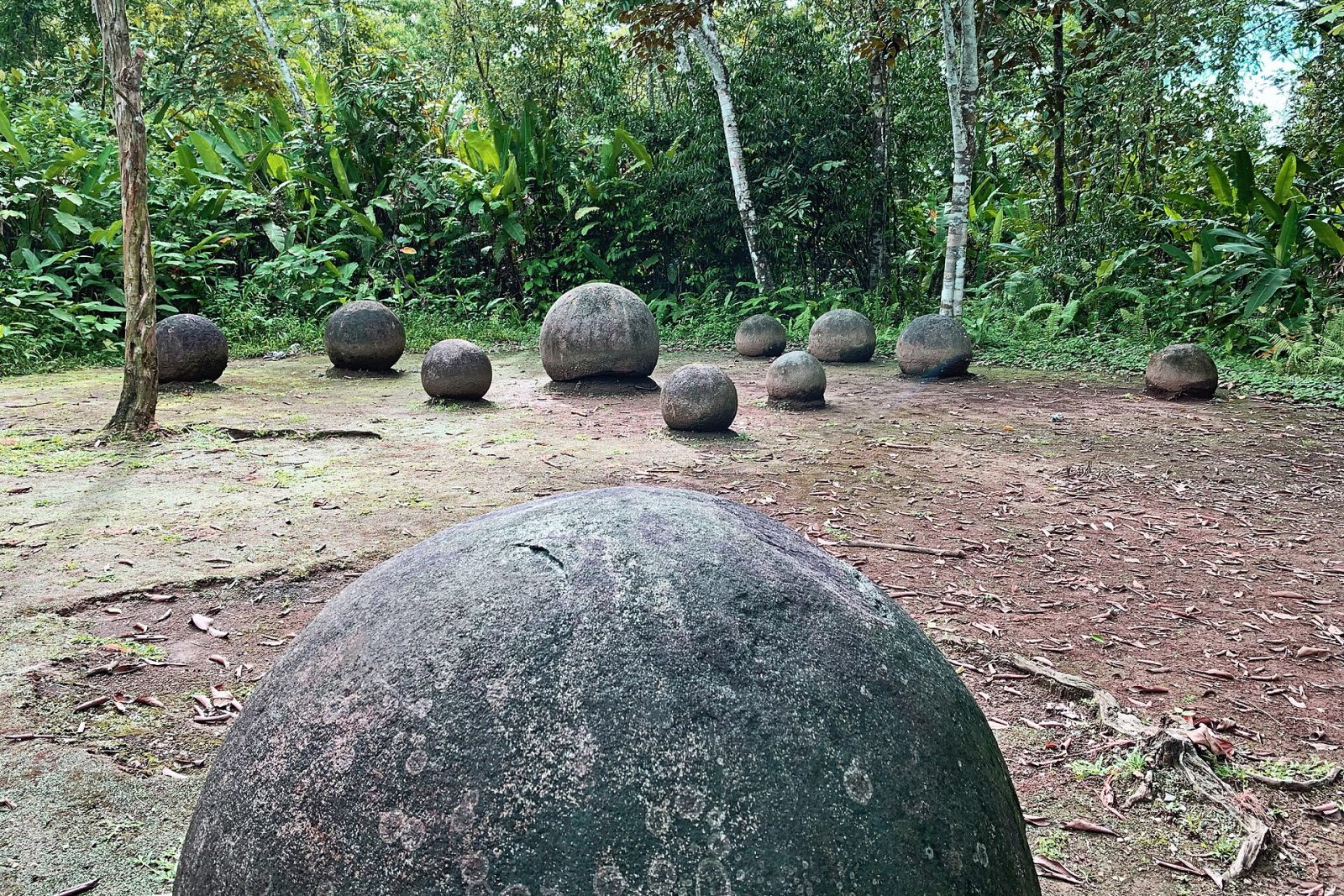
In the 1930s workers clearing jungle for United Fruit Company banana plantations in the Diquís Delta of southern Costa Rica found hundreds of nearly perfect stone spheres, some over two metres across. Made between about AD 800 and 1500, their purpose is still unknown.
In the 1930s, the United Fruit Company was clearing the forests of the Diquís Delta, the flood plain of the Río Grande de Térraba in southern Costa Rica, for banana plantations. As bulldozers pushed through the jungle, workers kept uncovering large stone balls, many of them almost perfectly round. Local people called them las bolas. Nobody recorded who found the first, and some may have been noticed even earlier, but the plantation clearances revealed them on a huge scale. The machines shoved many aside, scarred them and broke some apart, and according to many accounts workers drilled or blasted some with dynamite, hoping to find gold inside. They found only solid rock.
The first scientific study came in 1943 from Doris Stone, the daughter of a United Fruit Company executive, who went on to become a leading archaeologist of Central America. Samuel Lothrop of Harvard followed with a major study in 1963. About 300 spheres are now known. They range from a few centimetres to 2.66 metres across, and the largest, at El Silencio, is estimated by Costa Rica's National Museum to weigh around 26 tonnes. Most are made of gabbro, a hard volcanic rock, and were shaped by pecking and grinding, then polished with sand.
Archaeologists now believe they were made by the peoples of the region between about AD 800 and 1500, in a period when chiefdoms built villages with stone house foundations, pavements and mounds. Why they were made is still unknown. At Finca 6, the only known site where a group of spheres survives in its original arrangement, several lie in rough east-to-west lines, and some researchers have linked them to sunrise and sunset. "No theory has been proven so far," says the archaeologist Francisco Corrales of the National Museum.
Only about a dozen spheres remain where their makers placed them. Others decorate public buildings, parks and private gardens across the country. In 2014 four sites in the delta, including Finca 6, were made a UNESCO World Heritage Site, and the spheres can be seen at the Finca 6 museum and the National Museum in San José.
Written for Global Finds from Archaeology magazine (2014) and the National Museum of Costa Rica. Photo: stone spheres in their original positions at Finca 6, Diego Padilla Durán and Mario Roberto Durán Ortiz, Wikimedia Commons, CC BY-SA 4.0.
Source: Archaeology magazine (2014)