The Ingham Brass: an Alaskan detectorist found a priest's face from a medieval tomb, and gave it back to Norfolk
Famous find Engraved in the 15th century See it on the timeline →
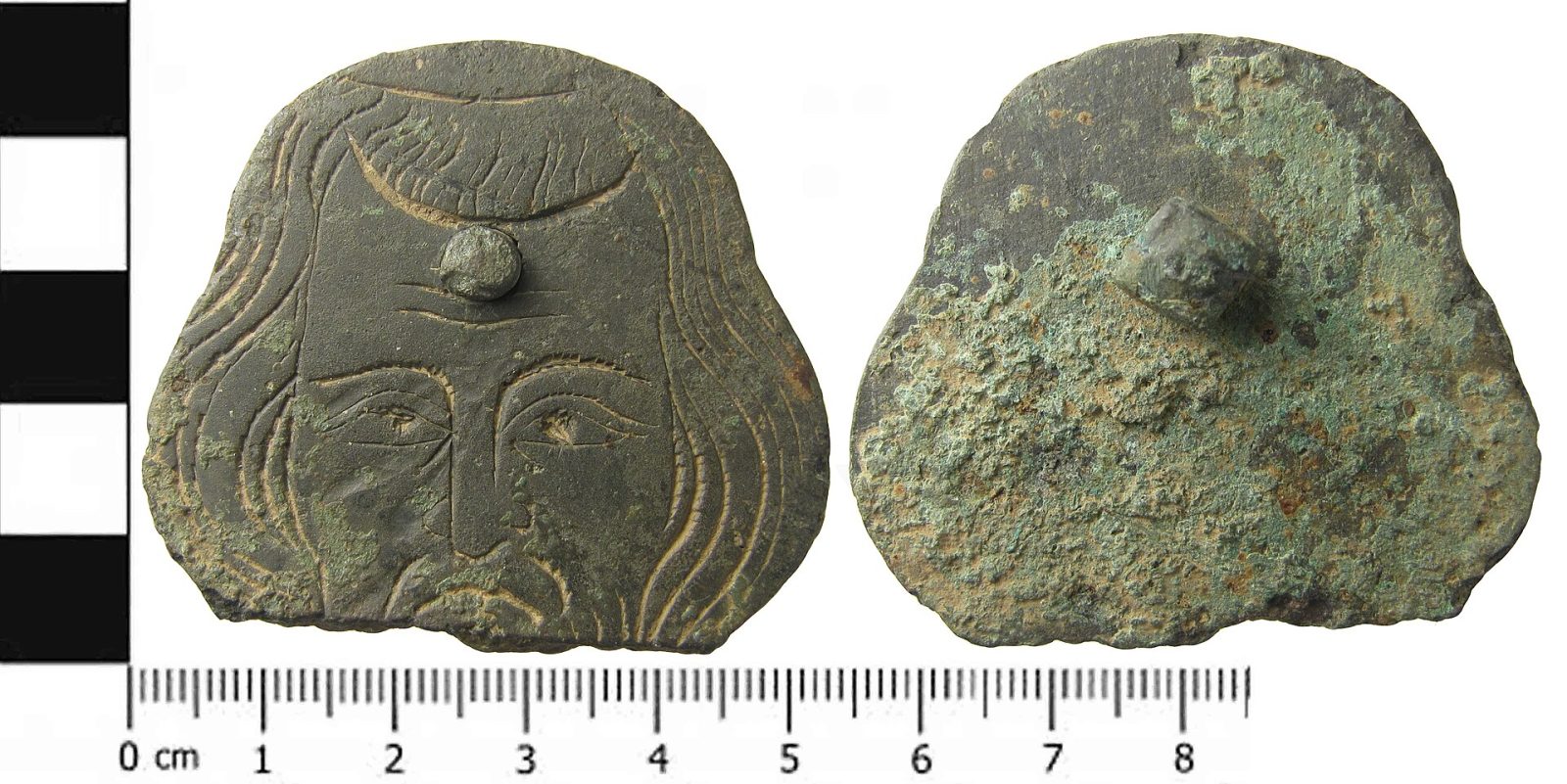
Stephen Wells, who travels from Alaska every year to detect in Norfolk, found a piece of engraved brass in a field near Holy Trinity Church, Ingham. It was part of a 15th-century monumental brass showing a tonsured priest, and he gave it to Norwich Castle Museum.
For about ten years, Stephen Wells has travelled from Alaska once a year to detect in Norfolk. On one trip, searching a field near Holy Trinity Church at Ingham, in the north-east of the county, he dug up a flat piece of engraved brass. Nobody, including the landowner, knew what it was. Wells had it recorded, and it turned out to be a fragment of a monumental brass.
Monumental brasses were engraved sheets of brass set into tomb covers and church floors, showing the dead with their coats of arms and inscriptions. The Ingham fragment shows a face and the top of a head with the shaved crown, or tonsure, of a priest, and it has been dated to the 15th century. The Diocese of Norwich describes it as potentially unique. Countless brasses were torn up and sold as scrap metal, and Ingham lost its own: a famous series of seven brasses to the Stapleton family was sold for the value of the metal around 1800. How this fragment reached the field is not known.
Its findspot makes it especially interesting. Holy Trinity was once the church of a priory of Trinitarians, a religious order founded in 1198 to ransom Christians taken captive during the Crusades. The priory was founded in 1360 by Sir Miles Stapleton, one of the founding Knights of the Garter. "Ingham can be seen as a status symbol of his position in society," said Tim Pestell, senior curator of archaeology at Norwich Castle. Ingham was the last of England's ten Trinitarian houses to be founded, and the only one with buildings still standing. Its church, shared by the priory and the parish, carried on as the parish church after the priory closed around 1536.
Wells contacted the Monumental Brass Society, but for a year the fragment hung on his wall in Alaska. On his next visit, the Ingham parishioner Mark Newstead helped persuade him that it belonged in a museum, and he has now given it to Norwich Castle Museum and Art Gallery. "It's your history, not mine," he said, "and you should have it on your wall."
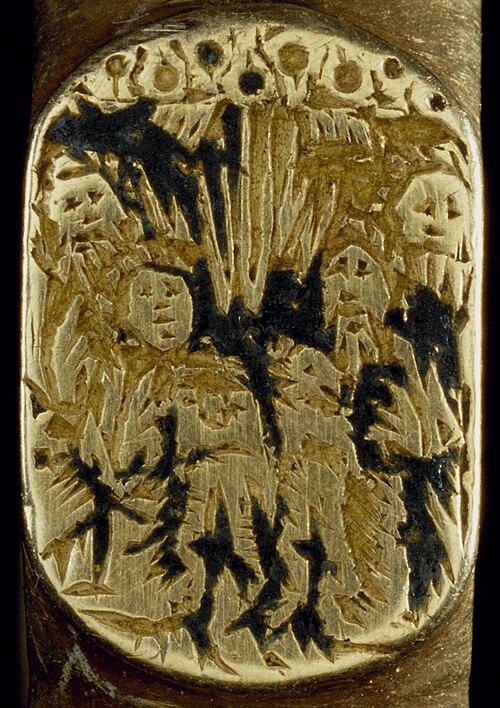
Written for Global Finds from the Diocese of Norwich (2026), quoting the finder, Tim Pestell of Norwich Castle Museum and Mark Newstead, and the Church Monuments Society (Badham, 2006). Photo: another fragment of a medieval monumental brass, a head found in West Yorkshire, not the Ingham brass, Amy Downes, West Yorkshire Archaeology Advisory Service, Portable Antiquities Scheme, Wikimedia Commons, CC BY-SA 4.0.
Source: Diocese of Norwich (2026)