The Rangoon Gold Relics: labourers levelling a pagoda for British barracks found a Mon queen's funeral treasure
Famous find 15th century, perhaps about 1400-1420 · Found in 1855 See it on the timeline →
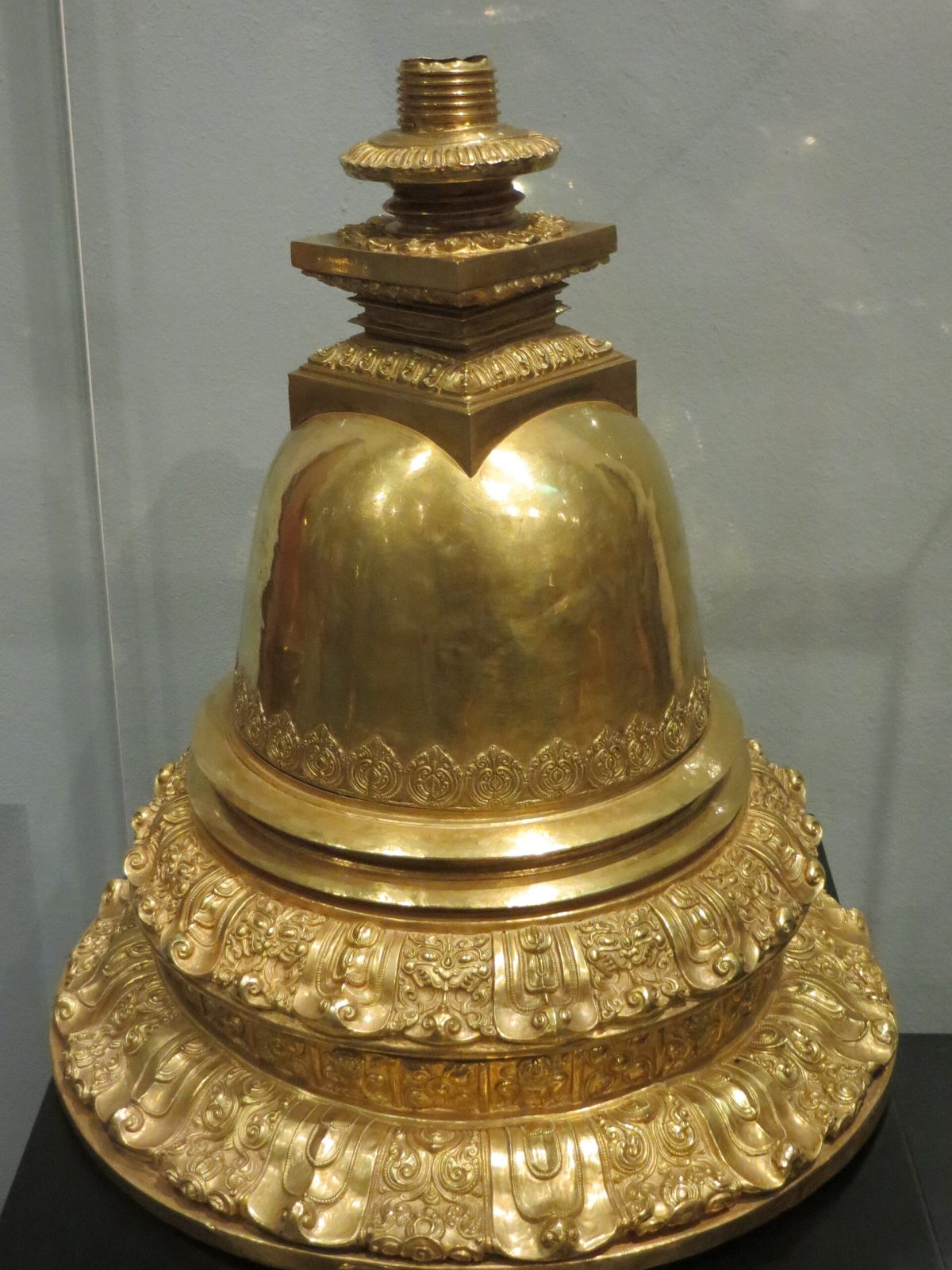
On 13 April 1855, labourers clearing an old brick stupa near the Shwedagon Pagoda in Rangoon for new British barracks found nine gold objects, among them reliquaries, a jewelled headdress and a bowl of burnt bone. The surviving pieces are in the V&A in London.
On 13 April 1855, two years after Britain took Lower Burma in the Second Anglo-Burmese War, labourers in Rangoon were clearing ground for new barracks. The site, on high ground about a quarter of a mile south-east of the great Shwedagon Pagoda, was covered with small, old brick stupas. As they levelled one of them, they found a chamber holding nine objects of gold.
There were three gold reliquaries shaped like stupas, a gold headdress set with precious stones, a gold tassel, a small gold cup topped with a ruby, a jewelled gold belt, an inscribed gold band, and a covered gold bowl holding 21 fragments of burnt bone. All were made of thin gold sheet worked in repoussé. The finest surviving reliquary stands 34 centimetres high, decorated with lotus petals, lions and grinning kirtimukha masks. The headdress is shaped like a Burmese turban.
The inscription on the gold band, in Pali, recorded gifts made at a royal cremation. The historian Donald Stadtner has read it as naming the Mon king Rajadhiraj, who reigned from about 1384 to 1420, and argues that the bones are probably those of his queen, making the deposit her funerary stupa. The Victoria and Albert Museum dates the pieces more cautiously to the 15th century, and the British Museum has suggested about 1450 to 1530. When the band was first translated, in 1855, its numbers were misread, which led to a wrong date that was corrected in 1858.
The relics went to Calcutta and then to the East India Company's museum in London, and in 1879 to the South Kensington Museum, now the V&A. Not all of them survive. The belt, the cup and the inscribed band disappeared in the museums' care, and the finest reliquary, set with rubies, was disposed of in 1958 for reasons unknown. The V&A still has the reliquary, headdress and bowl, and the reliquary was lent to the British Museum's "Burma to Myanmar" exhibition in 2023.
Written for Global Finds from the Victoria and Albert Museum collection records, Donald Stadtner in the Journal of the Siam Society (2015) and W. H. Sykes in the Journal of the Royal Asiatic Society (1860). Photo: the gold stupa reliquary in the V&A, Jononmac46, Wikimedia Commons, CC BY-SA 3.0.
Source: Victoria and Albert Museum