The Cyrene Bronze Head: dug from under a Roman floor in Libya's Temple of Apollo, with its glass eyes still in place
Famous find Made about 300 BC, or perhaps in the 2nd century BC · Found in 1861 See it on the timeline →
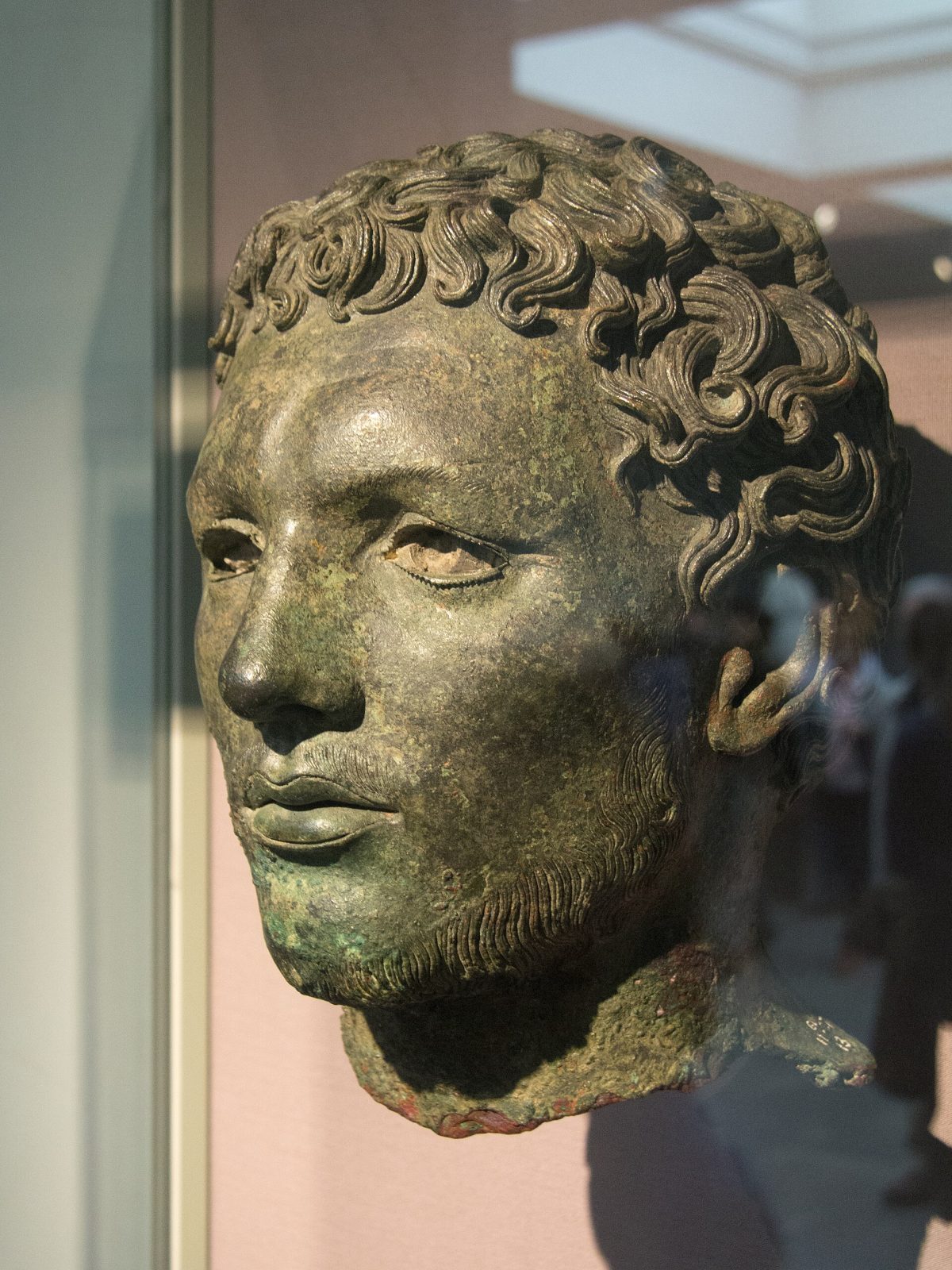
In August 1861 two British officers, Robert Murdoch Smith and Edwin Porcher, found a life-size bronze head on the original floor of the Temple of Apollo at Cyrene in Libya. It portrays a North African man, perhaps a Numidian prince, and is now in the British Museum.
In the summer of 1861 two British officers were digging through the ruins of the Temple of Apollo at Cyrene, the Greek city on the green uplands of eastern Libya. Lieutenant Robert Murdoch Smith of the Royal Engineers and Commander Edwin Porcher of the Royal Navy had left the eastern half of the temple's inner chamber until last. They reached it in August. Eleven feet down, below a Roman mosaic floor and lying on the temple's original pavement, was a bronze head.
It is life-size and hollow, cast by the lost-wax method. The beard, moustache and eyebrows are finely incised, the eyelashes are notched strips of bronze, and the eyes were inlaid with glass, fragments of which are still in the sockets. Even the lower lip was cast separately and fitted. Around it lay burnt fragments of bronze horses' legs, pottery lamps and flakes of gold leaf. The head had belonged to a larger group, probably gilded in places and perhaps a horseman or a chariot celebrating a victory, and it seems to have been destroyed by fire.
Who was he? Smith and Porcher thought the features looked "rather African than Greek or Roman", and wondered whether he was a king of Numidia or Mauretania. The British Museum describes him as possibly one of the Berber peoples of North Africa and dates the head to about 300 BC, when Cyrene was one of the richest Greek cities in Africa. In 2002 the historian Duane Roller argued that this date had been accepted largely out of habit, and that the portrait shows Mastanabal, a son of the Numidian king Massinissa, in the middle of the second century BC. If he is right, the officers' first guess was remarkably close.
The head was shipped to London and registered at the British Museum in November 1861. It is usually displayed in Room 22, the world of Alexander. Cyrene itself became a UNESCO World Heritage Site in 1982, and since 2016 it has been on UNESCO's list of sites in danger.
Written for Global Finds from Smith and Porcher, History of the Recent Discoveries at Cyrene (1864), the British Museum collection record and Duane Roller in the Journal of Hellenic Studies (2002). Photo: the Cyrene bronze head in the British Museum, Zde, Wikimedia Commons, CC BY-SA 4.0.
Source: Smith and Porcher, History of the Recent Discoveries at Cyrene (1864)