The Risan Hoard: 4,656 coins of an Illyrian king, still in their pot under a burnt house floor on the Bay of Kotor
Famous find Coins of about 260-230 BC, buried perhaps 229-228 BC · Found in 2010 See it on the timeline →
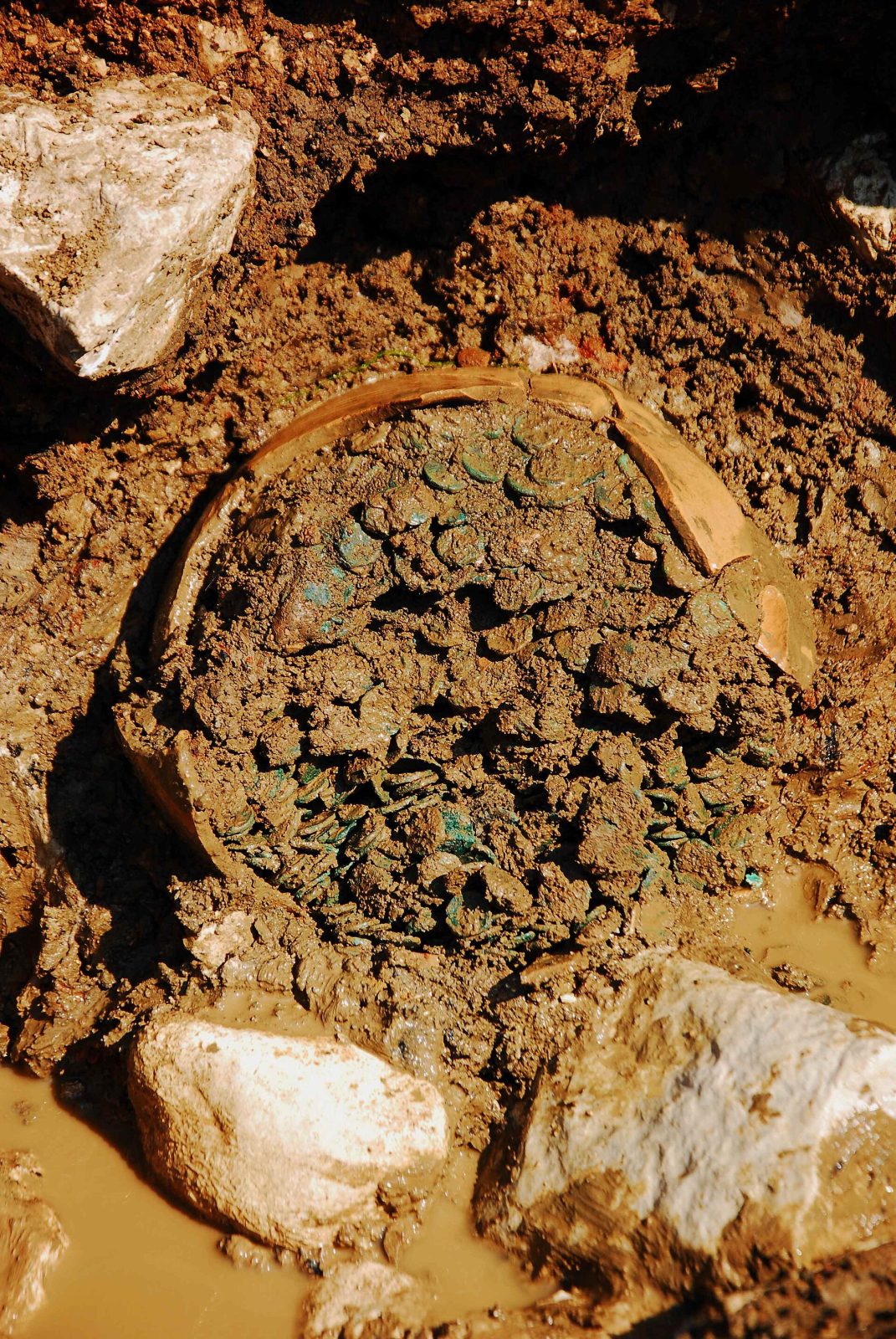
In June 2010 a University of Warsaw team excavating ancient Rhizon, now Risan in Montenegro, found a pot under a house floor packed with 4,656 bronze coins of the Illyrian king Ballaios. Weighing nearly 15 kg, it may have been hidden as Rome went to war with the Illyrians.
Risan sits at the head of the Bay of Kotor in Montenegro, on the site of Rhizon, a town of the ancient Illyrians. For more than twenty years a team from the University of Warsaw, led by Professor Piotr Dyczek, has been excavating it. In June 2010 they were working in a Hellenistic house on the west bank of the little Špila river. Under the floor of one of its rooms, beneath a layer of burnt debris, they came upon a pot. It was packed with coins.
The pot was a water jar capped by a cup, and inside were 4,656 bronze coins weighing close to 15 kg. All were coins of Ballaios, a king of the Illyrians whose reign is usually placed around 260 to 230 BC. His coins carry a man's head and the words "King Ballaios" in Greek, with the goddess Artemis on the other side. It is one of the largest ancient coin hoards known from the Illyrian lands. The sheer number, at the very place they were used, supports the idea that Rhizon was where Ballaios struck his coins.
Why was it never recovered? The burnt layer above it suggests the house was destroyed. Radiocarbon dates from that layer may link the destruction to the First Illyrian War of 229 to 228 BC, when Rome fought the Illyrian queen Teuta, who had made Rhizon her capital. The Greek historian Polybius says that she withdrew to Rhizon as the war went against her. Whether the owner of the coins fled or died, nobody can say, but the pot stayed where it was hidden for more than two thousand years.
The coins were published by the Warsaw team in the journal Novensia in 2010. In 2012 the same excavation found a second, smaller group of more than a hundred Ballaios coins in another house. More than a century earlier, the British archaeologist Arthur Evans had also picked up coins of Ballaios at Risan. The published reports do not say where the great hoard is now kept.
Written for Global Finds from Ciołek and Dyczek in Novensia 21 (2010), archaeology.wiki (2012) and Polybius, Histories, book 2. Photo: the Risan hoard in its pot as found, Janusz Recław, Wikimedia Commons, CC BY-SA 4.0.
Source: archaeology.wiki (2012)