The Scar boat burial: an Orkney farmer kept a Viking weight in his kitchen drawer for six years, thinking it was part of a car battery
Famous find Viking Age, about AD 875-950 · Found in 1985 See it on the timeline →
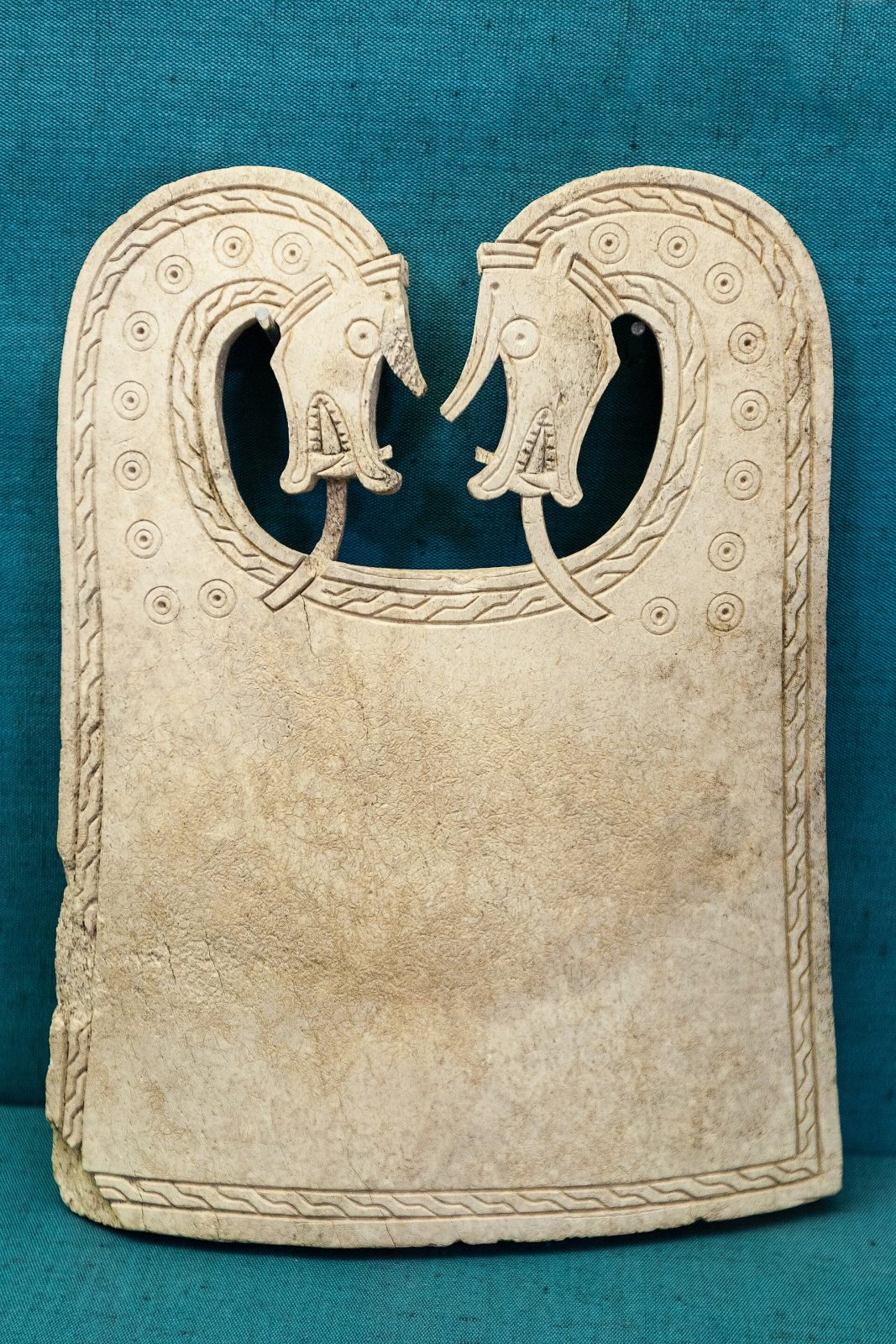
In 1985 a storm cut into a sandbank at Scar on Sanday, Orkney, and farmer John Dearness saw bones and picked up a small lead object. In 1991 it was recognised as a Viking weight, and a rescue dig found a boat burial of a man, a woman and a child, with a superb whalebone plaque.
In 1985 a storm cut away part of a sandbank on the shore at Scar, on the island of Sanday in Orkney. A few days later the local farmer, John Dearness, noticed bones sticking out of the bank and thought he had found the grave of a drowned sailor. Nearby he picked up a small lump of lead about the size of a pound coin. A friend told him it was part of a car battery, and it went into a kitchen drawer.
It stayed there for six years. In 1991 the Orkney county archaeologist, Julie Gibson, came to look at the eroding bank. John had died by then, and Caroline Dearness showed her the lead object. Gibson recognised it as a Norse weight for weighing silver. She and Dr Raymond Lamb found boat rivets in the bank, and in November and December 1991 Historic Scotland carried out a rescue excavation, led by Magnar Dalland, racing the winter storms. One side of the grave had already gone into the sea.
The boat had been a rowing boat about 6.5 m long. All the wood had rotted, but more than 300 iron rivets kept its shape in the sand. In it lay three people: a man of about 30, a woman of about 70 and a child of about 10. With the man were a sword, a quiver of eight arrows, a comb and 22 gaming pieces. With the woman were a gilded brooch, a comb, a sickle, a weaving sword, shears, spindle whorls and a carved whalebone plaque. The last find of all, a second lead weight, was picked out of the beach stones by an archaeologist with a metal detector.
The plaque is about 27 cm tall, with two beasts' heads facing each other at the top. It was probably used as a board for smoothing linen. About sixty such plaques are known, and the Orkney Museum calls this one of the finest. It was almost certainly made in Norway between 750 and 850, so it was already old when it was buried. The grave dates from about AD 875 to 950. The plaque, sword and brooch are shown in the Viking gallery of the Orkney Museum in Kirkwall.
Written for Global Finds from the Orkney Museum and History Hit. Photo: the Scar whalebone plaque, Orkney Museum, MichaelMaggs, Wikimedia Commons, CC BY-SA 4.0.
Source: The Orkney Museum