The Rossett lead pig: a Wrexham detectorist stopped digging when he saw Roman letters, and found the only inscription naming Nero's governor in Britain
Famous find Cast under Nero, AD 63-69 · Found in 2019 See it on the timeline →
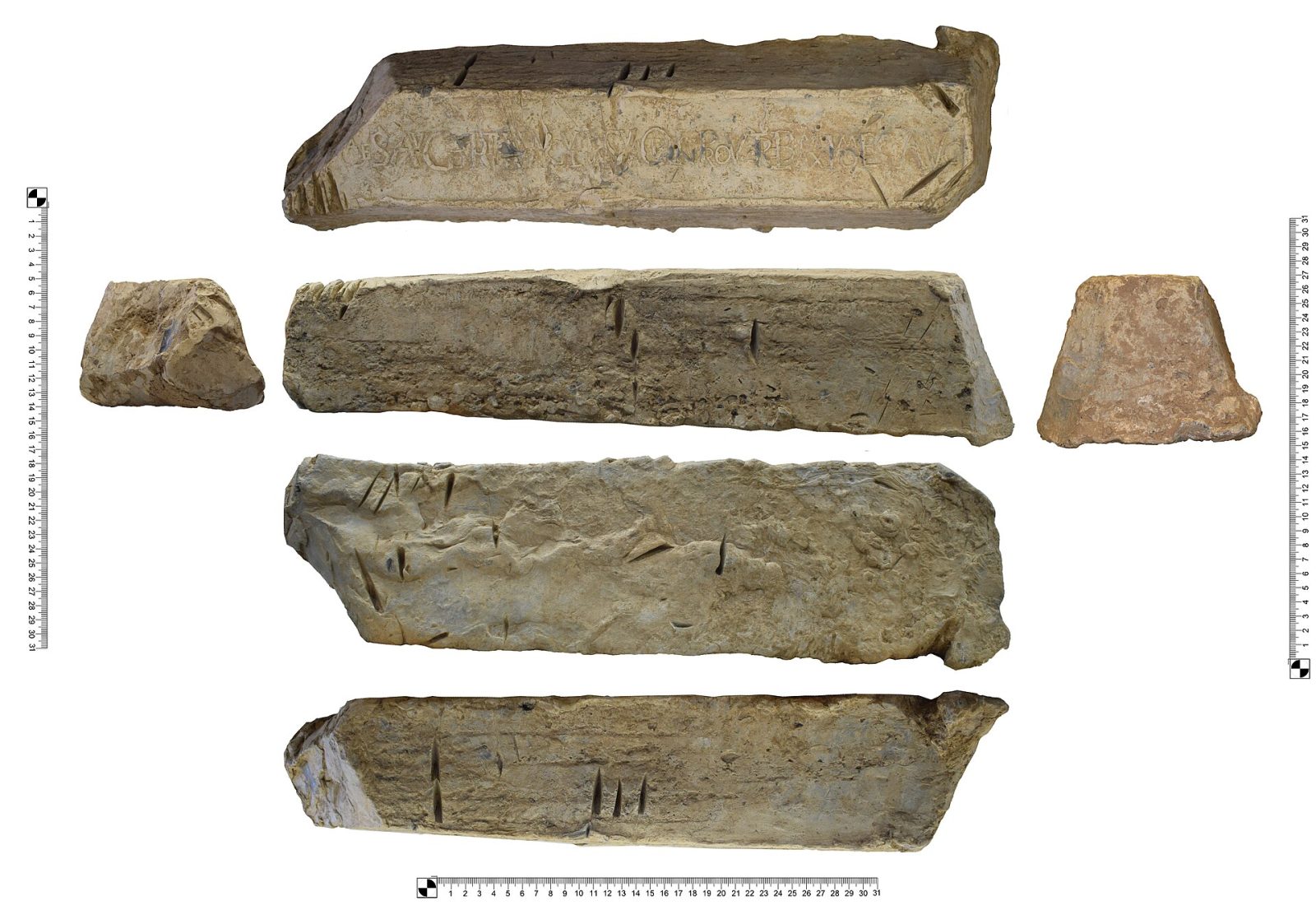
In September 2019 detectorist Rob Jones found the corner of an inscribed lead block in a field near Rossett, Wrexham, and called the Finds Officer. It was a 63 kg Roman ingot cast under Nero and naming the governor Trebellius Maximus, and it led to North Wales's first known Roman villa.
In September 2019 Rob Jones of Coedpoeth, who had been metal detecting around Wrexham since 1996, got a signal in a field near Rossett and uncovered the corner of a heavy lead object with raised lettering on it. Instead of digging it out, he stopped and called Susie White, the Portable Antiquities Scheme Finds Officer for north-east Wales at Wrexham Museum. The object was recorded and examined while it was still in the ground.
It was a Roman lead ingot, or "pig", 53 cm long and weighing 63.4 kg. One end is missing and every face carries cut marks. Its layers show that it was poured in four batches. Along the top, in raised letters crowded with joined characters, is an inscription that Roger Tomlin of Roman Inscriptions of Britain reads as the lead "of Nero Caesar Augustus, British lead from Magul…, smelted at the works in the province while Trebellius Maximus was imperial legate". Marcus Trebellius Maximus governed Britain from AD 63 to 69. This is the only inscription naming him found in Britain. Fewer than a hundred inscribed pigs are known from Roman Britain.
Where the lead was mined is not settled. A scan by the University of Liverpool pointed to a local source in north-east Wales, perhaps around Minera or Ffrith, but fuller lead-isotope tests are still hoped for. Tomlin links "Magul…" with a Roman place called Magalonium, whose site is unknown. The field itself showed no Roman buildings, and the pig may have been lost or hidden on its way somewhere.
Wrexham Museum bought it with help from the Arts Council England/V&A Purchase Grant Fund, the Headley Trust and the Friends of Wrexham Museums, and put it on show in September 2020. Roman objects found nearby by other local detectorists led to a survey that found a Roman villa about 1.7 km away at Burton, Rossett, announced in November 2020 as the first of its kind in north-east Wales. In 2026 a dig with DigVentures and the University of Chester found a complete quern stone below the stone villa and rooms with an underfloor heating system that may have been a bath house. The pig is in Wrexham Museum's collection.
Written for Global Finds from Roman Inscriptions of Britain (Brit. 51.90), Wrexham Council (2020 and 2021), the Roman Research Trust, the University of Chester (October 2026) and Earth.com. Photo: the Rossett lead pig, National Museum Wales, Susie White, Portable Antiquities Scheme, Wikimedia Commons, CC BY 2.0.
Source: Roman Inscriptions of Britain