The Carpow logboat: a detectorist on the Tay mudflats spotted a 3,000-year-old boat carved from a single oak
Famous find Late Bronze Age, about 1260-910 BC · Found in 2001 See it on the timeline →
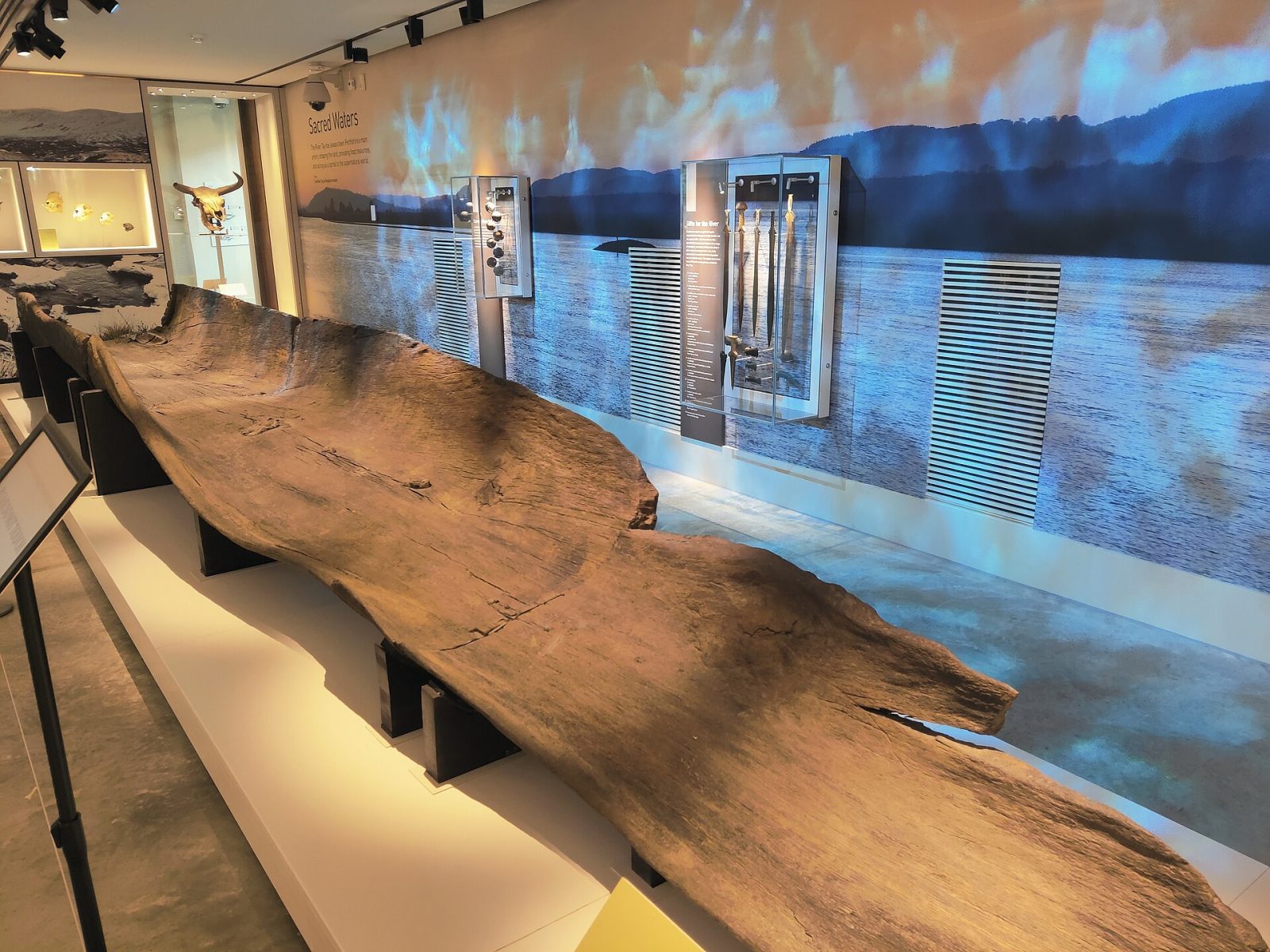
In August 2001 detectorist Scott McGuckin recognised a timber eroding from Carpow Bank, on the River Tay near Abernethy, as a logboat. It was carved from one oak trunk in the Late Bronze Age, about 3,000 years ago, and is now the largest object in the new Perth Museum.
In the summer of 2001 the River Tay ran unusually low. In August the metal detectorist Scott McGuckin was out on the mudflats of Carpow Bank, on the south side of the Tay estuary near Abernethy in Perth and Kinross, when he noticed a long timber sticking out of the eroding mud. He recognised it as part of a logboat, a boat carved from a single tree trunk, and reported it.
Radiocarbon dating showed that the oak was felled between about 1260 and 910 BC, in the Late Bronze Age. It is one of the oldest boats known from Scotland. About 9 m of it survives; the bow has gone, and the whole boat was probably no more than 11 m long. It was hollowed from an oak that had grown for about 400 years, and it could have carried around 14 people, or a crew of two with about a tonne of cargo. At the stern a separate D-shaped board of oak, the transom, is still in place, sealed with moss. There are footrests for the person steering, holes along the top edge, ancient repairs and the marks of socketed bronze axes.
For five years the boat lay where it was found while its condition was watched. In July and August 2006 the Perth and Kinross Heritage Trust, with CFA Archaeology, National Museums Scotland and Perth Museum, dug it out in seven days, working around the tides. It was floated on barrels, towed 3 km to Newburgh quay and lifted onto a lorry. National Museums Scotland cut it into three sections, soaked them in a chemical that replaces the water in the wood, and freeze-dried them, work that took until 2012.
The logboat went on show at Perth Museum and Art Gallery in 2012. In 2022 and 2023, when the wood had begun to flatten, conservators gently reshaped it using electric blankets. It is now the largest object in the new Perth Museum in the former City Hall, which opened in 2024, shown near Bronze Age swords from the Tay. When a full-size replica was made, it had to be carved from Douglas fir, because an oak big enough can no longer be found in Britain.
Written for Global Finds from the Perth and Kinross Archaeological Research Framework (SCARF), Perth Museum (2023) and the Perth and Kinross Heritage Trust. Photo: the Carpow logboat in Perth Museum, Thetaywhale, Wikimedia Commons, CC BY 4.0.