The Corleck Head: an Iron Age god with three faces spent decades on a Cavan farm gatepost, where children threw stones at it
Famous find 1st-2nd century AD (by style) · Found in 1855 See it on the timeline →
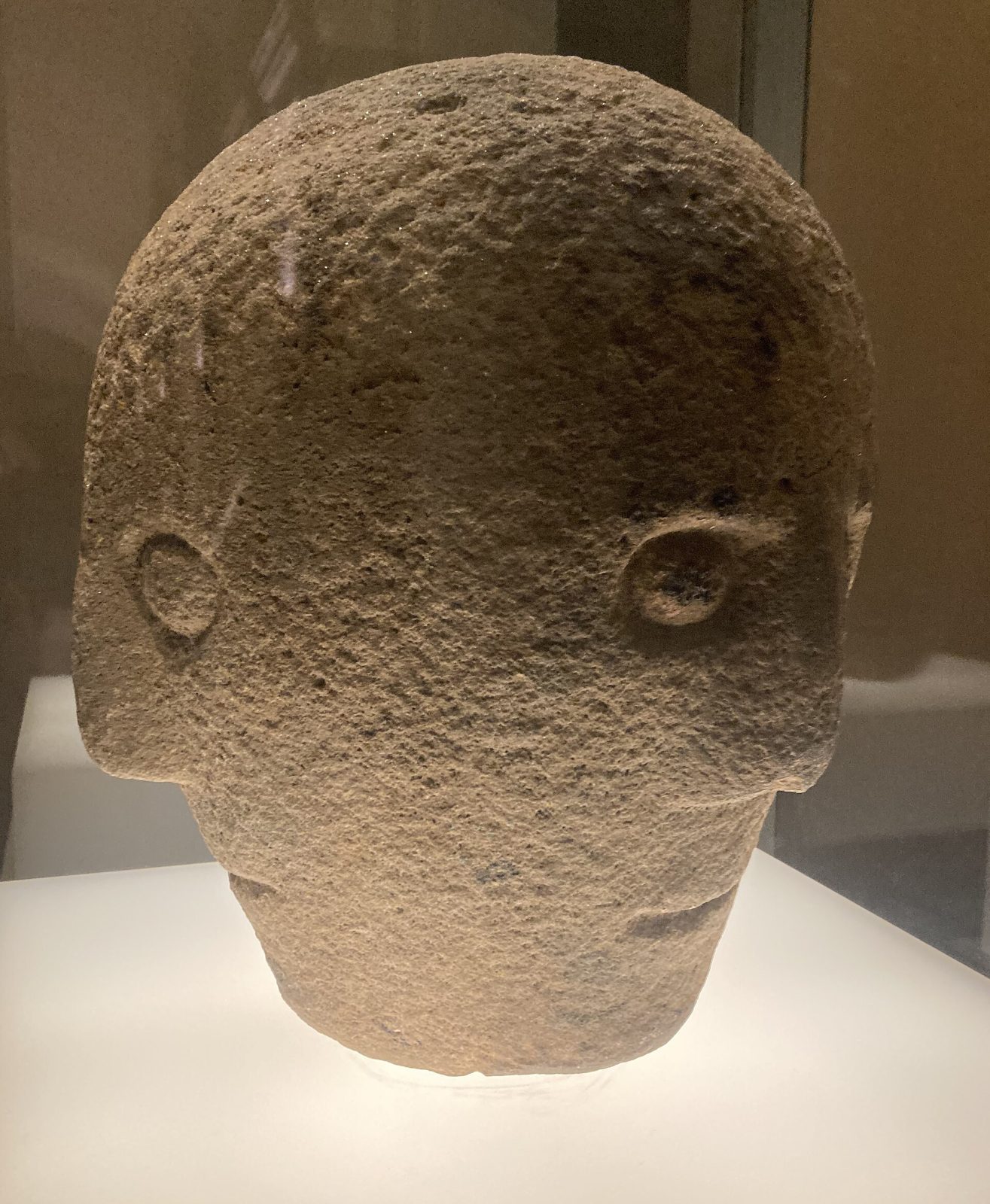
Around 1855 a farmer gathering stones near Corleck Hill in County Cavan found a carved head with three faces. It stood for decades on a farm gatepost before a folklorist recognised it in the 1930s. Probably of the 1st or 2nd century AD, it is now in the National Museum of Ireland.
Around 1855 a farmer at Drumeague, near Corleck Hill in County Cavan, was gathering stones to build a farmhouse. Later accounts name him as James Longmore. Among the stones he found a carved head. He did not build it into his house. Instead it ended up on top of a gatepost on the farm, where it stayed for decades as a local curiosity. A relative of the family who later owned the farm remembered throwing stones at it as a child.
In the 1930s the folklorist and schoolteacher Thomas J. Barron, who was recording the antiquities of the area, recognised what it was. In 1937 Adolf Mahr, director of the National Museum of Ireland, borrowed it, and the museum later acquired it. It is now one of the best-known objects in the museum's archaeology galleries on Kildare Street in Dublin.
The head is about 32 or 33 cm tall and carved from a single block of stone (sources disagree on whether it is limestone or sandstone). It has three faces, each with bulging eyes, a straight nose and a slit of a mouth. One mouth has a small hole bored into it. A hole in the base suggests that it was once mounted on a pedestal or post. Three-faced heads are known from the Celtic world on the Continent, and many archaeologists read them as a god who could see in every direction, or as a symbol of the power of the number three.
The Corleck Head is usually dated to the 1st or 2nd century AD, but only by its style. Nothing found with it can date it, and the archaeologist Ian Armit has warned that some stone heads in Ireland and Britain were made in a folk revival in the 17th and 18th centuries. The area around Corleck seems to have been a ritual centre: other carved stone heads have been found nearby, among them the Corraghy Heads, which a later farmer partly smashed. The name Drumeague is said to mean "ridge of death". Fintan O'Toole included the Corleck Head in his series A History of Ireland in 100 Objects.
Written for Global Finds from Fintan O'Toole, A History of Ireland in 100 Objects (The Irish Times, 2011), the National Museum of Ireland and other published accounts. Photo: the Corleck Head in the National Museum of Ireland, Ceoil, Wikimedia Commons, CC0.
Source: The Irish Times (A History of Ireland in 100 Objects)