The Glasinac bird chariot: soldiers digging a road in Bosnia broke into a burial mound and found a bronze wagon carrying a duck
Famous find 8th-7th century BC · Found in 1880 See it on the timeline →
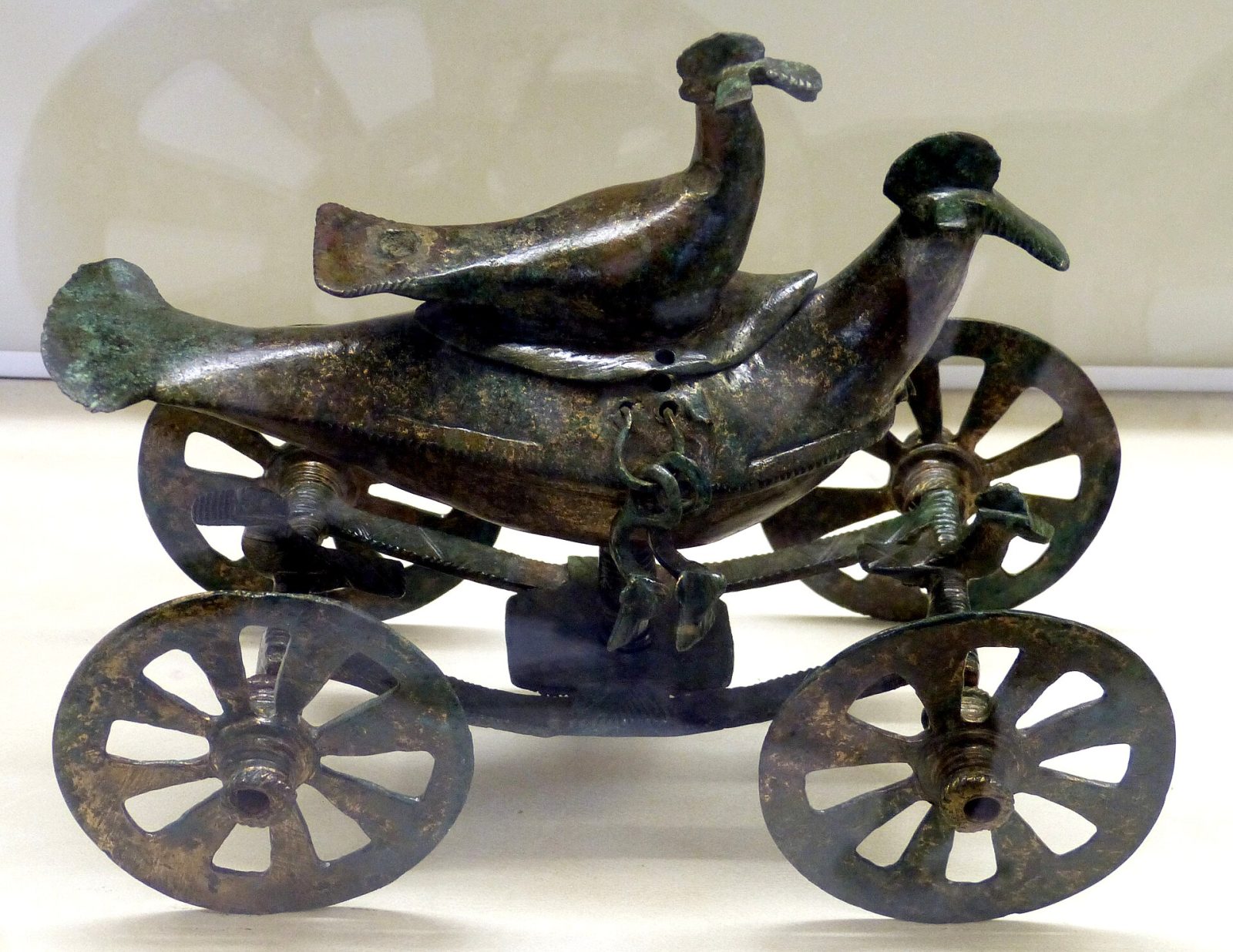
In March 1880 Austro-Hungarian soldiers building a road across the Glasinac plateau in Bosnia dug into stone burial mounds for rubble. One held a small four-wheeled bronze wagon carrying a duck-shaped vessel. About 2,700 years old, it is now in the Natural History Museum in Vienna.
In March 1880, two years after Austria-Hungary occupied Bosnia, army engineers were building a strategic road from Sarajevo towards Rogatica and Višegrad. On the Glasinac plateau, near Sokolac, they needed stone for the road bed, and beside the bridge over the little Rešetnica river stood four large mounds of it, 21 to 28 m across. The soldiers dug into them. They were Iron Age burial mounds.
The finds were sent to Ferdinand von Hochstetter at the court museum in Vienna by Lieutenant Johann Lexa of the 1st Engineer Regiment, stationed at Goražde. Accounts differ on how carefully the work was done. Hochstetter wrote that Lexa was not present for the digging, while a later account says that he excavated the fourth mound himself. According to Lexa's report, that mound held a skeleton in the centre, with a bronze vessel, a massive bracelet and a small bronze wagon, and six or seven more burials around its edge.
The wagon is about 18.5 cm long and 15 cm high and weighs about 1,055 g. It has four wheels, each cast in one piece as a pierced disc, which once turned on iron axles that have mostly rusted away. On it sits a vessel shaped like a duck or water bird, open at the back, whose lid is a second, smaller bird. Both have little wings below the head. It is usually dated to the 8th or 7th century BC. Small cult wagons with water birds are known from other parts of Iron Age Europe, and they are thought to be ritual objects, perhaps linked to a sun cult or to the journey of the dead. A recent suggestion is that it carried burning embers or incense.
Hochstetter published the finds in Vienna in 1881, and they caused a stir. They helped spark serious archaeology in Bosnia: the National Museum in Sarajevo was founded in 1888, and more than 1,200 Glasinac mounds were excavated in the following decade. The wagon itself is in the prehistory collection of the Natural History Museum in Vienna, and a replica is in the National Museum of Bosnia and Herzegovina in Sarajevo. In 2025 it appeared on a Bosnian postage stamp.
Written for Global Finds from Blagoje Govedarica, "Cult chariot from Glasinac", Godišnjak ANUBiH (2022), the Natural History Museum Vienna and BH Pošta (2025). Photo: the Glasinac bird chariot in the Natural History Museum, Vienna, Wolfgang Sauber, Wikimedia Commons, CC BY-SA 4.0.