The Chorro de Maíta bird: a tiny gold head in a Cuban grave turned out to have been made 1,500 km away in Colombia
Famous find Made in Colombia AD 1000-1500, buried early 1500s · Found in 1986 See it on the timeline →
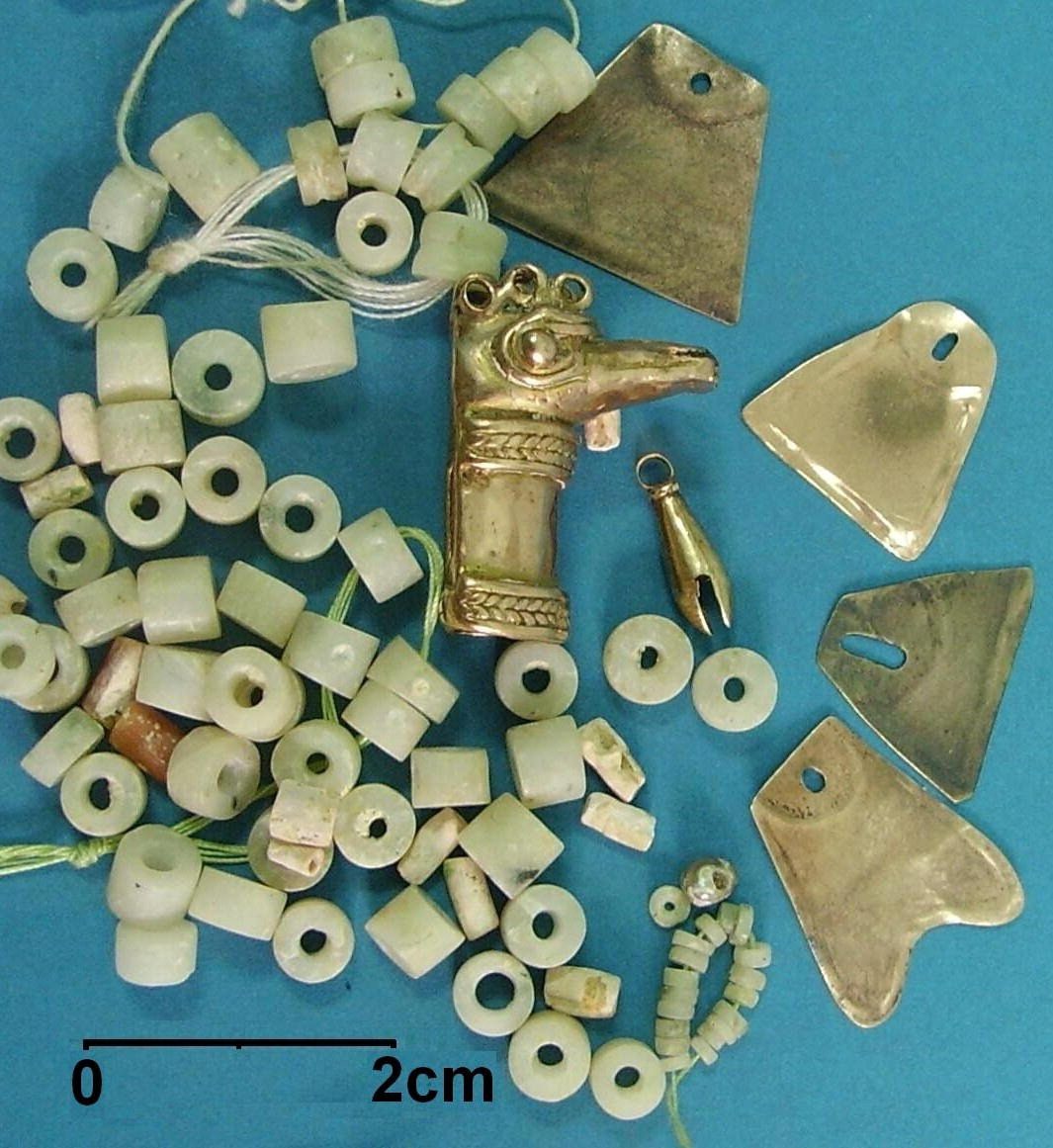
Between 1986 and 1988 Cuban archaeologists excavated a cemetery at El Chorro de Maíta, near Banes, long known to local farmers for the bones in their fields. A young woman's grave held a hollow gold-alloy bird head 2.3 cm long, later shown to be the work of Tairona goldsmiths in Colombia.
For most of the 20th century, farmers at Yaguajay, near Banes in eastern Cuba, kept turning up human bones and old objects when they dug foundations or planted crops. The place was reported in 1927 and explored by the American archaeologist Irving Rouse in 1941. The real work came later. Between 1986 and 1988 a team from the Holguín branch of the Cuban Academy of Sciences, directed by José Manuel Guarch Delmonte, excavated a cemetery there, at a site called El Chorro de Maíta.
Burial 57 was a young woman, aged about 19 to 21. Between her collarbones lay the remains of a necklace, and at its centre was a hollow bird's head 2.3 cm long and weighing 3.7 g. It was cast by the lost-wax method in guanín, an alloy of gold, copper and silver prized by the Taíno people of the Caribbean. With it were four thin sheet pendants of the same kind of metal, a tiny bell, minute gold beads, beads of coral, pearl and quartz, and pieces of European brass.
In 2012 a team led by Marcos Martinón-Torres and Roberto Valcárcel Rojas analysed the metal and the style. They concluded that the bird was made by Tairona goldsmiths in the Sierra Nevada de Santa Marta of Colombia, about 1,500 km away, where it probably crowned a larger chest ornament. The Gold Museum in Bogotá has one almost identical. In Cuba this broken fragment became the centrepiece of a high-ranking woman's burial. Radiocarbon dates show that the cemetery was in use after about 1510, in the first decades of Spanish rule, which explains the brass.
Later study changed how the whole site is seen. It now appears to have been an early colonial settlement of Indigenous people held under the encomienda, the Spanish system of forced labour. The cemetery's 133 burials include people from elsewhere in the Caribbean, one from Mesoamerica, one African and two of mixed descent. El Chorro de Maíta is a Cuban National Monument, and a site museum opened over the cemetery in 1990. The finds are held by Cuban heritage institutions.
Written for Global Finds from Martinón-Torres, Valcárcel Rojas, Sáenz Samper and Guerra in the Journal of Anthropological Archaeology (2012), Valcárcel Rojas and colleagues on the new research at El Chorro de Maíta, and the journal Islas (Universidad Central de Las Villas). Photo: the finds from burial 57, with the bird head at the centre, Roberto Valcárcel Rojas, Wikimedia Commons, CC BY 3.0.
Source: Journal of Anthropological Archaeology (2012), via UCL