The Canterbury Cross: a bronze brooch dug up in a city street became a symbol copied in cathedrals around the world
Famous find Made about AD 850 · Found in 1867 See it on the timeline →
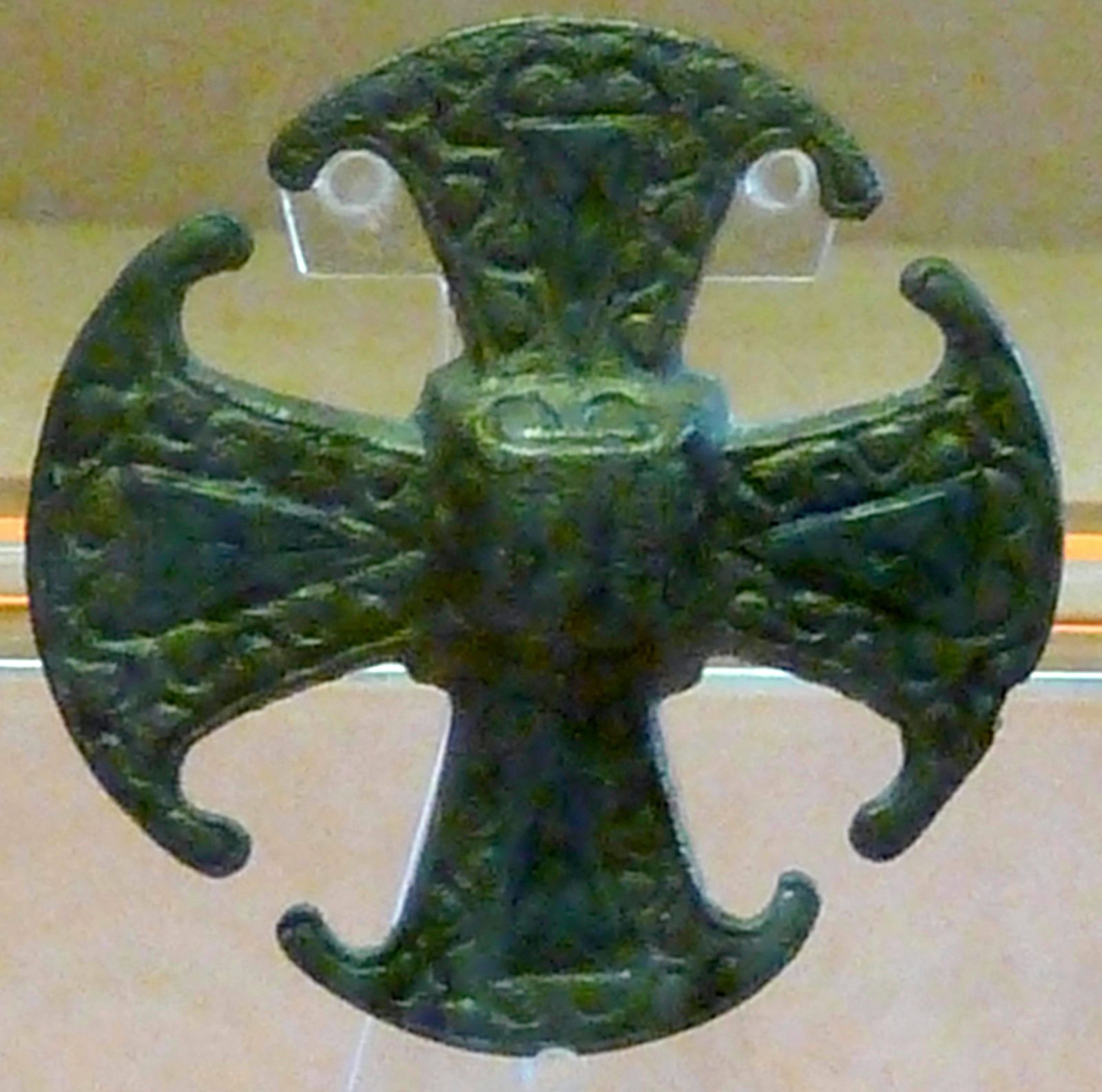
In 1867 workmen digging in St George's Street, Canterbury, turned up a small Anglo-Saxon bronze brooch shaped like a cross, inlaid with silver. Copies of it were later sent to Anglican cathedrals across the world, and it became the emblem of Canterbury itself.
In 1867 and 1868, St George's Street in the centre of Canterbury was dug up for building and street works, close to where St George's Tower stands today. During the excavations, workmen found a small brooch of cast bronze in the shape of a cross. Nobody recorded who picked it up. By 1879, when the local historian John Brent drew it for his book Canterbury in the Olden Time, it belonged to a collector named Mr Pool, and Brent noted that many modern brooches called the Canterbury Cross had already been designed from it.
The brooch is about 6.4 centimetres across. Its four arms flare out from a raised central square, and their ends are curved, so that together they form a circle, like a wheel. Each arm holds a small triangular panel of silver, engraved with a triquetra, a three-cornered knot often read as a symbol of the Trinity, and inlaid with niello, a black metallic inlay. A wavy vine pattern runs around each panel. On the back are small hooks for fastening it to clothing. It was made around AD 850, when Canterbury was the seat of the archbishop and a busy Anglo-Saxon town, and it was probably simply lost by its owner.
The brooch later belonged to William Trimnell, a Canterbury jeweller, who left it to a local doctor, Harold Wacher. After Dr Wacher's death in 1949, his family gave it to Canterbury's museum.
By then the design had already gone round the world. In 1935, copies of the cross mounted on stone were sent to Anglican cathedrals across the world, among them twenty in Australia, fifteen in Canada and eleven in South Africa. A copy hangs in the nave of Canterbury Cathedral itself, and the design appears on street bollards, memorials and countless pieces of jewellery. An ordinary dress-fastener, lost in a street, became the best-known symbol of the city.
Since 2022 the original has been on loan from Canterbury Museums and Galleries to Canterbury Cathedral, where it is displayed in the crypt.
Written for Global Finds from the Canterbury Archaeological Society, D. R. Lewis, "Canterbury Cross" (2014), J. Brent, Canterbury in the Olden Time (1879), and Canterbury Cathedral (2022). Photo: the original Canterbury Cross, Storye book, Wikimedia Commons, CC BY-SA 2.5.